Showing posts with label Science Fiction. Show all posts

Sunday, 23 September 2018

I've Just Seen: Independence Day (1996)

 Director: Roland Emmerich

I vaguely remember this film being released, but was too young to see it at the cinema. I believe it was played a few times at school, but I don't remember watching it. If this film holds any significance today, it is as a barometer for how much blockbusters have changed in the last two decades. Other than that, I can't think why it is considered a must-see film.

The film is incredibly stupid in so many ways it is impossible to go through them; perhaps the most glaring is the use of the internet to download a virus onto the alien aircraft using Earth internet, but several thousand kilometres away from Earth (what the hell!!). None of the characters have much character development: the president is suitably bland - we get no sense of his political persuasion, only that he is thought to be too young for the job. One woman is shown to work as a pole-dancer, for no reason other than that's something male screenwriters seem to think is a big employer of women (tagent: I'd love to do a survey of all the jobs women are depicted having in films: I bet sex worker and stripper would be disproportionately high compared to actual jobs women have in real life). The disparate characters all eventually and predictably end up meeting and working together. And, of course, America saves the day.

While the film's visual effects have aged, I don't really have a problem as this happens to pretty much every film. And 22 years later they don't look that bad; other films have fared less well. However, the overwhelming Americaness of the whole endeavour (it just happens to be set around America's Independence day) just put me off. Apparently the rest of the world was just along for the ride.

Compared to the recent Arrival, Independence Day looks immensely stupid and violence heavy. If it shows any thought, it is in the rather pessimistic way it depicts conquering forces as destructive. But even this is giving the film too much credit. Its stupid, shallow and ultimately unsatisfying.

Thursday, 8 February 2018

I've Just Seen: Star Wars: The Last Jedi (2017)

 Director: Rian Johnson

Well, I liked it.

So much has been said about Johnson's installment in the Star Wars trilogy, and a lot of it is divisive, that it is hard to formulate your own individual response. You end up answering the criticisms of others. And as I heard a few of the general criticisms before I saw the film, I had them floating in my mind while watching the film.

I am not someone who engages with any of the non-films storylines of the Star Wars saga. So for me the films have to work with the other films; you can't explain away any plot holes or inconsistencies with "Oh it is explained here in this story, or comic, or wherever." They have to work as a whole, which is one of the reasons the prequels don't work; they created more answers, and I do wonder if Lucas actually watched the first three before he scripted them.

I was excited to see the new Star Wars films, having enjoyed The Force Awakens with its new characters, well-constructed script and polished and rather beautiful cinematography. And for the most part, The Last Jedi delivered similar levels of brilliance. The only area I thought needed work was the structure of the script regarding Finn and Rose's plotline (a criticism others have made).

I enjoyed the focus on the nature of The Force and the platonic attraction between Rey and Ren. The "good guys" and "bad guys" in Star Wars are usually so diametrically opposed that it is hard to imagine a "good" character going bad (hello Anakin in the prequels). But Johnson cleverly explored this through the Force channel between the two, as well as Luke's fall from grace.

I could say a lot about the film, but simply saying I overall enjoyed it feels enough. Seeing Carrie Fisher on the big screen one last time was bittersweet. She is wonderful, and though it was not intended to be a farewell the film does provide a lovely last arc for Leia's story.

It is certainly a different Star Wars than what we are used to seeing, but for me that is fine.

Thursday, 26 October 2017

I've Just Seen: Barbarella (1968)

 Director: Roger Vadim

The chauvinism and sexism of Vadim's films is hard to stomach at times. I have seen a few of his movies now, and can't say I want to see anymore. Barbarella at least has some camp value, though the troubled production means that the film loses focus and all sense rather early on.

In a very distant future Jane Fonda's Barbarella, who is some sort of interplanetary special agent, is tasked with finding Dr Duran Duran, a scientist whose invention - a positronic ray - could be dangerous for Earth if one of the other planets get hold of it. So Barbarella goes looking for it, crash-landing on a planet supposedly more primitive than Earth (they have sex the "old-fashioned way"). Eventually she meets an angel, goes to Sogo where Dr Duran was last seen, and then ... things happen. Really, there is not point worrying about the plot of the film: the filmmakers started filming before they had even finished the script. This doesn't always spell disaster for a movie (Casablanca is a good example), but here it shows badly.

While the film is not great, it is campy enough to be vaguely enjoyable. The costumes are pretty eye-popping, and clearly inspired Paul Gaultier's costumes in The Fifth Element. The sets are also remarkable, especially Barbarella's spaceship, with its furry, carpeted walls. So 60s! Fonda is very good as Barbarella, and while the script subjects the character to several exploitative scenarios, she does get moments of comedy, and Fonda makes the most of them.

I am glad to have crossed a cult classic off my list, but feel that were I male, I may have got more out of this. As it is, I was impressed with Fonda's dedication to the role, the look of the film as a whole, and even some of the scenes are hilarious, like the demonstration of exaltation-transference pills (how future earthling have sex). But the sexism and cobbled together nature of the story and script are too big to ignore.

Tuesday, 26 September 2017

I've Just Seen: Re-Animator (1985)

 Director: Stuart Gordon

I love it when a horror film goes utterly crazy. It is both horrifying and hilarious, leaving you almost breathless with glee. Re-Animator, with its short running time, goes brilliantly mental very quickly (I'd say somewhere around the re-animated cat), and just when you think it can't get more ridiculous, it does.

Jeffrey Combs is perfect as the 'mad scientist' Herbert West, whose invention - a reagent that reanimates people - has horrible side-effects on the reanimated corpse. He is obsessively focused on his invention and can't help using it, even when doing is a really bad idea (like reanimating he man trying to take credit for his invention). Combs' West's bluntness and inability to suffer those he sees as foolish make him appear almost the most sane, or at least calm, character in the film.

The story follows West as he tries to fine tune his invention in America. He takes up with a follow medical student, Dan Cain (owner of the cat), and somehow Dan's girlfriend Megan's father ends up as one of the corpses. Into the mix is West's nemesis Dr Hill, who also has a thing for Megan. The film's ridiculous plot adds another layer of humour.

The other great element of Re-Animator is its opening titles sequence and theme, which is iconic enough to be parodied in The Simpsons. It is reminiscent of Psycho, and points to the coming madness and chaos of the story.

Re-Animator has everything one wants in an 80s cult horror film: humour, gore, an iconic central performance, a brilliant theme, and a nice chilling ending to round it all off. Great fun!

Thursday, 27 July 2017

I've Just Seen: The Last Battle (Le Dernier Combat) (1983)


Director: Luc Besson

Besson's debut film is not strictly a silent film; it has a lot of sound and noise on its soundtrack, from whistling wind, to pelting rain, and clanging gates. But there is not dialogue, apart from one word -  'bonjour' - and the post-apocalyptic setting implies some sort of event has happened rendering humans speechless; the characters work very hard to say this one word. The black-and-white cinematography gives this science-fiction story a timeless quality: it is set in the future, but also harks back to early cinema.

The story follows 'The Man' around this desolate world of urban ruin and environmental bleakness. The first we see of him is having sex with a blow-up doll in a dilapidated apartment, the first of many striking images in this film. He leaves this place after some unknown men pursue him, flying in a handmade aircraft. The Man eventually meets with 'The Doctor,' a man living a another town, who has a secret that another man, 'The Brute' (played by Besson regular Jean Reno), is trying to get at. The Doctor fixes The Man after he crashes, and eventually reveals his secret to him. In the final third of the film The Man and The Brute battle over this secret.

As I said, this film has several interesting images in it. The most startling is the scene of fish falling along with rain on the town, and The Man gleefully gathering them up in a giant pile. Later pieces of rock fall like rain on The Man and The Doctor. The Man's first "home" is an old office block and he sits at a desk, still with some paraphernalia on it, but instead of carpet there is sand on the ground. We never learn what has happened, yet we know that it is something cataclysmic.

I was really impressed by this film, particularly knowing it was a debut feature. Besson has become well known for weird, brightly coloured and fast-paced science-fiction, so watching where he started off is very interesting. We are given few answers as to why the world has been all but destroyed, and instead experience the brutal level of survival the characters are living.

Thursday, 1 June 2017

I've Just Seen: The Creature From the Black Lagoon (1954)

 Director: Jack Arnold

This horror-science-fiction monster movie about an aquatic gill-man who terrorises a group of scientists has aged since it was released. Parts of it are still interesting, but it is much less action packed than other 50s sci-fi films, and its plot isn't much more than an excuse for lots of underwater shots - particularly of a swimsuit clad woman.

The underwater shots, and the look of the gill-man are the reasons to see the film. The film was originally shot in 3D, and this would have been most effective in the underwater scenes. There is a dreamy quality to them, with the shimmering light coming from the surface, and the pockets of bubbles rising from the scuba gear of the characters. One shot has the bubbles dance into the camera, and it is great to look at. There are also shots looking up at Julie Adams' swimming silhouette that reminded me of Jaws.

Gill-man's costume is also impressive. We do see it in its entirety early on, but only get real close-ups of it later in the film. The fish-like head does look quite scary, though it doesn't have much movement or expression, beyond a stunned mullet look (which is appropriate). The science talk in the film is rather fun, especially the opening explanation of evolution, with its depiction of a pre-human world - all tempestuous water and mysterious mist!

I did enjoy this, but the slow pace, and the smallness of the story does lessen its horror, and its feels like it is straining to fill its eight minutes running time. I missed the melancholy of The Incredible Shrinking Man, or the darkness of Forbidden Planet. Still, its worth seeing.

Friday, 12 May 2017

I've Just Seen: The Stepford Wives (1975)

 Director: Bryan Forbes

When I watched the horror film Teeth, about a girl with a set of teeth in her vagina, I wondered how I'd react differently to the film if I were male. I found that film rather funny, and certainly enjoyed Dawn's exploration of her newfound power, but could imagine that the laughs coming from a man watching the film would be accompanied by winces and sympathetic leg-crossing for Dawn's victims (despite deserving punishment). With The Stepford Wives I often joined in the fear and rage of Katherine Ross's Joanna as she and her friends uncover the awful secrets beneath Stepford tranquility. But I was also curious as to what feelings the film would evoke in a man?

I'd imagine almost all would find the behaviour of the spouses in the film repulsive, but would it raise any conflicting feelings as well? Of course it all comes down to the individual's approach to women, but it is something I would be interested to learn.

As to the film itself, parts of it are dated, being made and set in the 1970s, but for the most part the film still feels very relevant. The 'Stepfordised' wives speak like women out of commercials - something that seems to have blighted internet discourse - and are sexually compliant, telling Joanna and Bobbie that their relations with their husbands are just perfect! The men themselves are perfectly happy with their wives, and even Joanna's husband only expresses a vague regret at what is going to happen - but does nothing to stop it, or even warn his wife.

While it is light on the normal horror tropes of blood, scares and only has one scene in a dark, spooky house, The Stepford Wives is one of the most horrifying films I have seen. Its story of a person losing autonomy over their mind, and consequently their body, is a universal one, and it is obvious why Jordan Peele looked to Forbes' film when he made Get Out. Enslavement to a society that values freedom is truly terrifying.

Tuesday, 9 May 2017

I've Just Seen: The Incredible Shrinking Man (1957)


Director: Jack Arnold

This film is a great example of the ingenuity of pre-CGI special effects. The story is simple; a man, Robert "Scott" Carey, starts to shrink after encountering an unknown gas at sea. The doctors are at first baffled, then once they discover its cause, realise there is nothing they can do. Scott must reconcile himself to his fate. We travel down with him as the furniture gets larger, until a doll's house is his home, and the cat is a danger to his life (along with a tarantula).

This film is a lot bleaker than I thought it would be. Scott becomes depressed at his fate, making him are very realistic character: for some reason I assumed Arnold's film would focus on the action scenes inherent in the story. Instead, the images of Scott sitting a chair that's too big for him, and being stuck in the basement are coloured with his loss of relationship with his wife. We really care about Scott, and see how much of a nightmare his life has become.

The special effects really come into effect in the film's Third Act, where Scott is stuck in the basement of his house, a house his wife is leaving. A minor flooding of the floor becomes almost biblical, and the quest to get at some mouldy cake for food is as dangerous as scaling Mount Everest.

The final reflections of the film are poignant and much more philosophical than I was expecting. It really elevates the film as a whole, reminding us normal sized humans of our places on this earth - surrounded by microscopic organisms - and the universe, where we become infinitesimal ourselves. 


Tuesday, 28 March 2017

I've Just Seen: Fantastic Planet (La Planete sauvage/ Divoka planeta) (1973)


Director: Rene Laloux

Laloux's animated science-fiction film is certainly of its time. Not in its story: an alien planet ruled by giant blue humanoids called Draags, who keep humans as pets (Oms), is used as an allegory for the dehumanising way humans treat one another - something common to much sci-fi. No, what really places Fantastic Planet in the early 70s is the eerie music, visuals, and the stilted, slow pace of the dialogue.

The copy I watched was an English dub from the original French, but also had subtitles which I couldn't turn off. The words spoken, and the words on screen, did not always match up - usually they were phrased differently. This made an already trippy film even more strange.

The animation is not like the bright colours we see in mainstream animation - this is not Disney, Pixar or Studio Ghibli. There is a flatness to the visuals as well. However, the opening scene really captures the scale of the world of the Draags. We follow a naked mother carrying her baby as she runs terrified from something unseen. Suddenly some large blue hands enter the frame and play with her like she is a mouse. When she dies, the hands pick up the baby, and then we see the hugeness of the Draags (and these are only the children) compared to the Oms.

From there we spend the first part of the film learning about the Draags world as the young Om Terr grows up - each Draag week is equal to a human year, so Terr quickly grows older than his child-captor. Terr learns the secrets of the Draags' knowledge under the Draags' noses - they believe Oms are too stupid to learn anything. The story eventually kicks in as Terr escapes and encourages other Oms to revolt. They learn about how humans got to the planet Ygam, and exactly what Draags do when they meditate (one of the weirdest scenes in the whole film).

This animation is not for children as it deals with some rather adult ideas, and its visuals are way more abstract than mainstream animation. The allegory is not subtle, but the skill of the images, particularly the attention to scale, and the disquieting music, are the reasons to see the film.

Thursday, 16 February 2017

I've Just Seen: E. T.: The Extra-Terrestrial (1982)

 Director: Steven Spielberg

2016 saw me plug several large holes in my movie viewing. One of these was E.T., which it has taken me twenty-six years to see. Why, you may ask, did my childhood not include this landmark family film? Errrr... I will blame my parents (who did show me Star Wars at age seven, so go figure). I do wonder how I would have responded to it if I had been younger; in all honesty, I probably wouldn't have enjoyed it as much as I did seeing it as an adult. E.T. would have scared me as a child, but now I can appreciate his adorableness.

Spielberg knows how to balance entertainment and emotion in his films. Almost all of them have a moment of wonder, a scene that excites you but also moves the story on. That moment in E.T. is the flying bicycle across the moon, which naturally is the movie poster. It is still one of the most iconic shots in film history, and beautifully captures the film's themes of adventure in your own backyard, and the power of friendship.

The child actors in the film are all well cast, especially Henry Thomas as Elliott and Drew Barrymore as Gertie. Thomas has to give a performance of great emotional depth, and his scene at E.T. deathbed is something a few adult actors would struggle with. He handles it wonderfully.


Aspects of this reminded me of the way Pixar approaches films supposedly aimed at children. Both Pixar and Spielberg take the lives and emotions of children seriously, and trust them to cope with the sadder parts of life, like loss of loved ones. They also choose to see the world from the eyes of a child: a place of both wonderful things to discover, and fears to overcome.

Monday, 13 February 2017

I've Just Seen: The Bride of Frankenstein (1935)


Director: James Whale

People who say that Hollywood has become addicted to sequels of late clearly doesn't know their film history. Hollywood has always gone after the money if they see an opportunity to do so. And much like today's industry, the sequels are occasionally equal to or better than the original film. Considering the strength of the first film, this is saying something.

The Monster has always been a sympathetic character in all the tellings; the Mary Shelley's novel is even narrated by the Monster for sections (the scenario where the original story was written is alluded to at the film's start). Even when he kills people, we still understand his motivations, and care about him. Throughout The Bride we see the Monster naturally wanting a mate. This is nicely doubled with Henry Frankenstein's relationship with fiance Elizabeth. The most monstrous character of the film is Dr Pretorius, who wishes to continue Frankenstein's work.

The most iconic image of this film comes right at the end, that of the newly created Bride. She stands there in all her glory, both beautiful and terrible. It is a striking moment, though knowing Young Frankenstein as well as I do, I couldn't help but smile, remembering Madeleine Kahn's tribute to this scene. The film's ending is just as melancholic as you would want from a Frankenstein film.


Wednesday, 8 February 2017

I've Just Seen: Forbidden Planet (1956)


Director: Fred M. Wilcox

Pre-moon landing films have a different feel to more modern films. The images of men walking on the moon, or even seeing the earth from space were not yet part of modern culture. Filmmakers' imaginations roamed a little more freely. Special effects in these old films have a particular charm to them; these days you have the fall back of doing things in post-production if required, and some in the audience just think "That was done with CGI."

Couple these special effects with a clever adaptation of Shakespeare's The Tempest, a wise-cracking robot, a thoroughly modern electronic score, and with a plot that is much more about humanity than aliens than you might think, and you have one of the best science-fiction films of the 1950s, and of the genre in general.

Seeing Leslie Nielsen being both young and serious was a slight obstacle at first - and in some of the more sexist 50s scenes with Anne Francis' Alta I half hoped for a wisecrack just to cut through my  discomfort - but he is great as Commander Adams. He and his crew land on Altair IV and find the environment is the least hostile part of planet.

The sexism is what dates this film. Alta is portrayed as naive, not realising her self-designed clothes are making the earth-men uncomfortable; or that her physical interest in these men is unladylike. The male audience of the 1950s got to have it both ways: look at a pretty girl, and see her get reprimanded for being too showy. This, however, is the only negative things about this film. Forbidden Planet goes to some very dark places about the human subconscious and the way technology may one day interact with our thoughts.

Friday, 9 December 2016

I've Just Seen: The Invisible Man (1933)


Director: James Whale

If you come to The Invisible Man hoping to see a lot of Claude Rains, you will be disappointed. However, while his body may be absent, Rains' presence is felt throughout the film through his voice. He plays Dr. Jack Griffin, a scientist who has discovered a way to make man invisible, using a substance called monocane, but its use comes with a side-effect: it makes the user go mad.

Whale's film takes no time to get the story going, beginning with Griffin already invisible and on the run. His odd appearance - he looks like a mummy wearing his sunday best - naturally raises the suspicions of townsfolk, who decide they don't want him in Iping. This leads to the unmasking of the invisible man, and displays some of the most impressive special effects in pre-CGI history.

These special effects are really the main reason to see the film. Though it is easy to figure out how they achieved some of them, others were clearly a lot more difficult, and required great creativity from Whale and his crew. This is especially true for the scenes where Griffin interacts with food or his clothes.

One can tell this is a Pre-Code film because of the implied nudity of Griffin. I can't imagine post-1934 Hollywood putting images of a invisible, naked Claude Rains roaming the countryside into audiences' heads.

The film as a whole has the charm such early special effects films have, a tribute to the ingenuity of early filmmaking. The story and the characters are not as developed as they might be, but this doesn't take much away from the story. Rains, despite not being seen onscreen makes his presence felt, much as Michael Fassbender did in Frank, when he acted under a giant, papier-mache head. 

Friday, 25 November 2016

I've Just Seen: Arrival (2016)


Director: Denis Villeneuve

I feel that Amy Adams is a shoo-in for a Best Actress Oscar next year, though whether it will be for Arrival or Nocturnal Animals I don't know; she might even be doubly nominated, though that usually spells death for your chances, as it spilts the vote. I don't mind which it is, she was fantastic in both, though much more sympathetic in Villeneuve's movie.

There are touches of Contact, Interstellar and Close Encounters of the Third Kind, and well as a bit of 2001: A Space Odyssey in Arrival, and if you enjoyed any of those films, you will like this one. It balances the science and sentiment better than Nolan's film (in my opinion), and has a similar poetry to Spielberg's movie. And like Contact, Arrival focuses on the story of a capable, intelligent woman battling more macho, absolute approaches.

The theme of the story is communication, both with an 'Other' and with each other. Adams is linguist Dr. Louise Banks, who is recruited to establish communication with some mysterious aliens (are there any other kind?), and is aided by Jeremy Renner's theoretical physicist Ian Donnelly, and supervised by Forest Whitaker's Colonel Weber.

In a film like this, you need to establish a sense of awe about meeting the aliens, and Villeneuve does this wonderfully. The first time Louise and Ian go into the dark, hovering alien 'spaceship,' I felt their amazement and the overwhelming shock of it all. The black, curved, carved edges of the vessel, contrasted with the white light at the tunnel's end; the trippy way you get up into the ship (I won't spoil it); and most of all, the haunting sounds on the soundtrack, like whales moaning in the deep. From then on I was completely hooked.

Much like horror films, science-fiction relies on its soundscape, and Arrival's is superb. The aliens sound organic yet unearthly, with rumblings that sound a bit like the base notes on an organ. The whole film is presented in slightly muted, washed-out colours, as though it is permanently overcast. This adds a touch of melancholy, a continuation of the grief Louise experiences in the opening sequence, where her daughter dies from childhood cancer.

I must say that the ending rather pulls the rug out from underneath you, and I was left thinking 'Wait, what?'; but in a way that makes me want to see it again. Overall it is an affecting, beautiful film that feels uncomfortably timely in the context of current politics. Hopefully this will be seen by lots of people who take its message of talking and listening to heart.

Sunday, 20 November 2016

I've Just Seen: Naked Lunch (1991)


Director; David Cronenberg

What did I just watch?

I have really liked Cronenberg in the past; The Fly is fantastic, managing to be sickening and romantic and terribly sad all at once. Videodrome was a clever reflection on our relationship to technology and our access to extremely violent and sexual images. Both films contain some of the best use of practical effects in film history, with all their gore and squishiness. While that aspect is present in Naked Lunch I felt revolted by it all more than anything. But my revolusion was largely drawn from the characters and the story.

I can't tell you the plot of Naked Lunch, nor even how the title refers to what I saw, except that it is the name of one of William S. Burroughs' stories; the film incorporates biographical details as well as the story's plot. There is something about bugs, drugs, homosexuality, writing and spying, but the several plots don't fit together. While the acting is good, I cared for none of the characters, and though the film is not long, I just wanted it to be over.

If Cronenberg had focused more on one or two ideas from the story it would have been much more coherent. It is not that coherence is always required to enjoy a film; I still cannot pin down what Mulholland Dr.'s plot is, or exactly how The Big Sleep all fits together, but something else drew me in. All I wanted to do after watching Naked Lunch was cleanse my mind of what I had seen. 

Friday, 14 October 2016

I've Just Seen: Mad Max (1979)


Director: George Miller

Mel Gibson doesn't get enough credit for his ability to disappear into roles. I had to remind myself that this was the same man who played William Wallace in Braveheart, and Frank Dunne in Gallipoli. While his accent may drift into American occasionally, Gibson's Max Rockatansky is a much quieter role than Wallace, with Max's madness taking a while to fully unleash itself. And when it does, it is a cold rage driven by revenge.

Watching an action film set in the Australia landscape in the rural areas was slightly strange. I am not used to seeing such goings on in leafy green Victoria. Though the budget was clearly low, the thrown together quality adds to the sense of society disintegrating. Nothing is new or shiny, from the cars to the buildings and the clothes.

 The story is not new, but its familiarity allows the audience to focus on the action, letting them get swept up in it and not trying to remember how it all fits in. The editing is what really makes this film. From the heart-racing opening chase, we jump from one group to the other, without ever losing the overall arc of the scene. The high cut rate may be very common in action films today, but in the 1970s it would have felt new and exciting.

I decided to watch this series from the beginning, though by all accounts I should skip Thunderdome (I probably won't, but am wary of it), so I am yet to see the recent Fury Road. Mad Max is a great set-up to the dystopian Australia and the story of Max, leaving us at the end with a broken, grieving man who is no longer motivated by law-and-order, but by personal vengeance.

Tuesday, 24 May 2016

I've Just Seen: Invasion of the Body Snatchers (1978)

Invasion of the Body Snatchers (1978)

http://www.blogcdn.com/blog.moviefone.com/media/2010/04/bodysnatchers.jpg

Director: Philip Kaufman

I have not yet seen the 1956 film of which this is a remake, but if it is as good as Kaufman's version, I know I will like it. The 1970s version blends science-fiction and horror together, offering little by way of exposition, leaving us almost as much in the dark as the characters. The opening sequence shows us organic matter leaving a distant planet, making its way to earth through solar winds, and using plants to grow their own flowers. We then meet Elizabeth, a worker at the Health Department, who begins to notice changes in her boyfriend Geoffrey, who just happened to sleep near a small bouquet of these inter-planetary flowers.

Invasion of the Body Snatchers falls into the "bad" aliens type of close encounter films, though the alien themselves are not agressively hostile; they are simply acting on evolutionary impulses. Being gelatinous goo, they are rather undeveloped in terms of intelligence, and that is what gives this film is horrifying aspect. Humans, with our intelligence developed over many millennia, are so quickly reduced to basic impulses of procreating and consuming by these creatures, losing all emotions including empathy. This being the 70s, the ending is suitably pessimisitic, arguing for the power of conformity over an individual's fighting spiriting. While not the happiest of films, this is clever science-fiction horror, with good dose of gore to leave you squeamish.

And you won't trust pretty pink flowers ever again!


Thursday, 19 May 2016

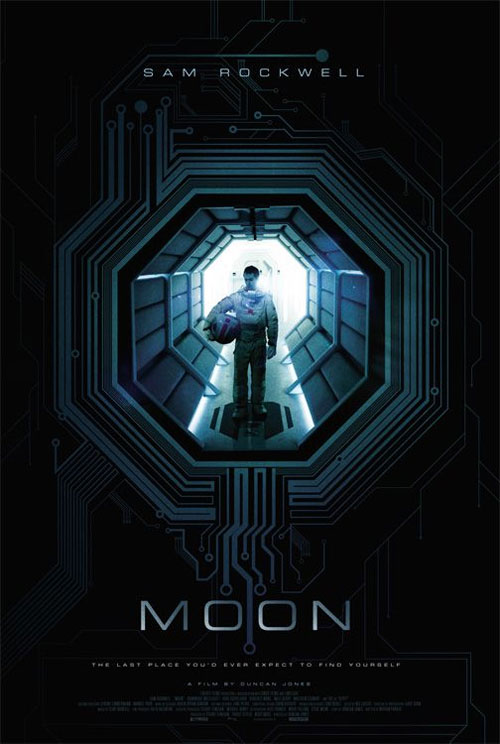
I've Just Seen: Moon (2009)

Moon (2009)

http://www.collectspace.com/review/moon_poster01.jpg

Director: Duncan Jones

Duncan Jones, in making Moon, wanted to recall the science-fiction films of his youth, the films that came out in the late seventies and early eighties which were about ideas with a streak of bleakness to them. He certainly succeeded with Moon, which follows a man, Sam Bell, working solo on the Moon, mining helium-3 from the rocks. Sam is nearing the end the end of his stay, and is looking forward to getting home to his wife and young daughter who was born after he left.

Sam Rockwell, known for his comedy, is fantastic as Sam Bell. Bell is lonely to the point of hallucinating, his only companion being a robot, GERTY, with the voice of Kevin Spacy, who expresses emotions through smiley and frowny faces which belie his more complex emotions towards Bell's existence. The plot has a great twist early on which is too good to spoil, and it raises questions around destiny, free will and the significance of human life. The design of the film is beautiful, with hints to rebel bases in Star Wars, and Kubrick's Discovery One in 2001.

If you love science-fiction you will love this film, not just for its story, but for the references and allusions to other classics of the genre.

Saturday, 9 April 2016

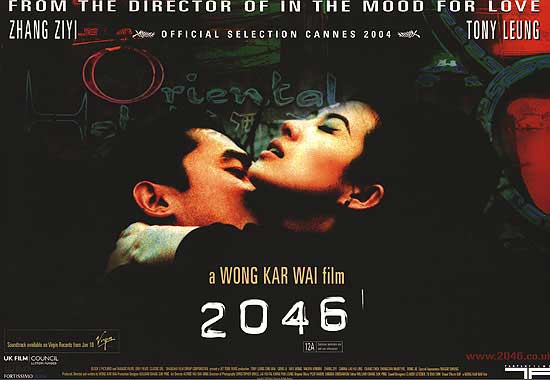
I've Just Seen: 2046 (2004)

2046 (2004)

http://dreamspire.fi/wp-content/uploads/2014/08/2046.jpg

Director: Wong Kar-wai

I love the aesthetics of the worlds Wong Kar-wai creates, filmed with an eye for colour and light that aids the romance of the characters. In the Mood for Love rivals Brief Encounter in its depiction of restrained, yearning unrequited love, and 2046 acts as a sequel to that story. We follow Chow Mo-wan after the dissipation of his affair with Su Li-zhen. He has left his wife, moved into a new apartment, and embarks on a series of affair with other women while also writing a science-fiction story set in the year 2046.

After the painful beauty and restraint of In the Mood for Love, 2046 is a bit of shock. It is louder and more explicit, with a timeline that jumps around in time and between Chow's fictional story and his real life. The brooding melancholy that is presence in so many of Kar-wai's films is present, but Chow's character feels less sympathetic than in the previous film. Everything still looks beautiful and I would watch Tony Leung Chiu-Wai in anything, but it suffers from comparison with In the Mood.

Worth a watch, but be prepared to have your ideas about the ending of In the Mood for Love completely dashed.

Monday, 28 March 2016

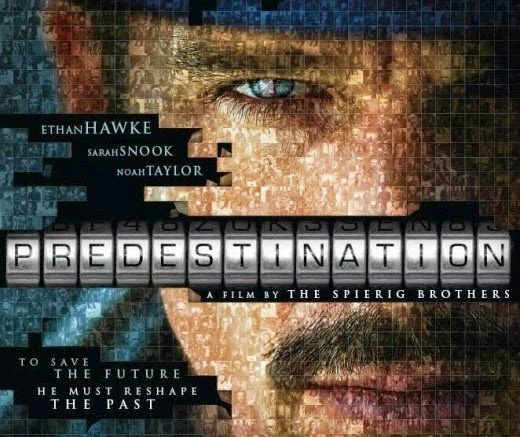
I've Just Seen: Predestination (2014)

Predestination (2014)

http://shaunpatten.com.au/wp-content/uploads/2014/07/predestination-review.jpeg

Directors: Michael Spierig, Peter Spierig

This is the type of film Australia rarely produces: slick science-fiction, set in another country (in this case, America). We meet Ethan Hawke's barkeep returning to work after an horrific accident that has required major facial reconstruction. One night he meets a man called John (Sarah Snook) who promises to tell the most amazing story, which starts with the line 'When I was a little girl ...' From here the movie becomes a time-travelling, identity slipping mystery.

Predestination's pace and tone is what stops the film's story from collapsing in a pile of incomprehensibility, as well as a brilliant performance from Sarah Snook, whose John looks a lot like Leonardo DiCaprio. There are few pauses in the action, so the audience doesn't have time to say 'Hang on, what?' Instead we are whisked away to the next section. The serious, dark tone also means that some of the more bizarre ideas don't stand out as much.

It is hard not to talk about the film without spoiling the story, but the big twist at the end was not as surprising as it could have been, and you a more likely not to have reached it because you were busy trying to keep up with the timeline. While far from perfect, it is a neat thriller with a great deal of style, and as stated previously, well worth seeing purely for Sarah Snook.