Director: Tsui Hark
Foshan, the setting for Hark's film, is presented as an incredibly international city, at least was in the late 19th century. It is a giant melting-pot of various Asian and Western countries, including America and Britain. At the centre of this world is Wong Fei-hung, a martial arts teacher and healer, and his coterie of apprentices and his '13th Aunt,' related to him by marriage and the woman he secretly loves. Another talented martial arts fighter arrives in town with the theatre, Leung Foon, who also adores '13th Aunt.' Wong, despite wanting peace, finds himself fighting with local gangs who have dubious connections to Americans who run a human trafficking ring.
Really, the plot is simply there to facilitate the fight scenes, and there are enough of them to keep you interested, or from cringing at the acting of the 'Americans.' Jet Li is good as Wong, and his fight scenes are a joy to watch. I also liked his quiet romance with Rosamund Kwan's '13th Aunt.' The depiction of this uneasy multicultural city was interesting, though I didn't known the history behind each country's presence there.
I did enjoy watching this, but am slightly unsure why it is on the 1001+ list. I can only think it is because it sparked an interest in martial art films at the time. It is good fun, but lacking in depth regarding its characters.
Showing posts with label Hong Kong Cinema. Show all posts
Friday, 23 June 2017
Sunday, 9 October 2016
I've Just Seen: The Blue Kite (1993)
Director: Tian Zhuangzhuang
The Blue Kite is a perfect example of why I enjoy watching 'world' films. I know very little of Chinese history, only that Mao's Communist Party took over mid-20th century. While Zhuangzhuang's film does not give an exact history of this takeover, it gives us a great insight into the impact this had on Chinese society, on a practical day-to-day level, and the emotional effect it also had on families. The story follows Tietou and his mother Chen as they try to make their way through this new world of strict party conformity in the absence of a patriarch.
The film is divided into three sections, the first named after Tietou's biological father, then his "Uncle" Li and then his Stepfather. We watch the tight, happy family unit slowly collapse as Tietou's father is betrayed, his 'Uncle's health fails, and his cold Stepfather try to save Tietou and his mother from the might of the Cultural Revolution.
There is a quiet tension to the story that becomes more prominent as Tietou grows up and realises what is happening around him. While the story is structured around Tietou's father figures, his mother Chen is strong presence throughout as she tries to keep her son safe. Liping Lu is fantastic as Chen, her youthful happiness giving way to despair.
The Blue Kite proved controversial in China and was banned. It is not loud in its damning of the spread of Communism in China, but its quiet power and emotive storytelling speaks volumes.
Wednesday, 29 June 2016
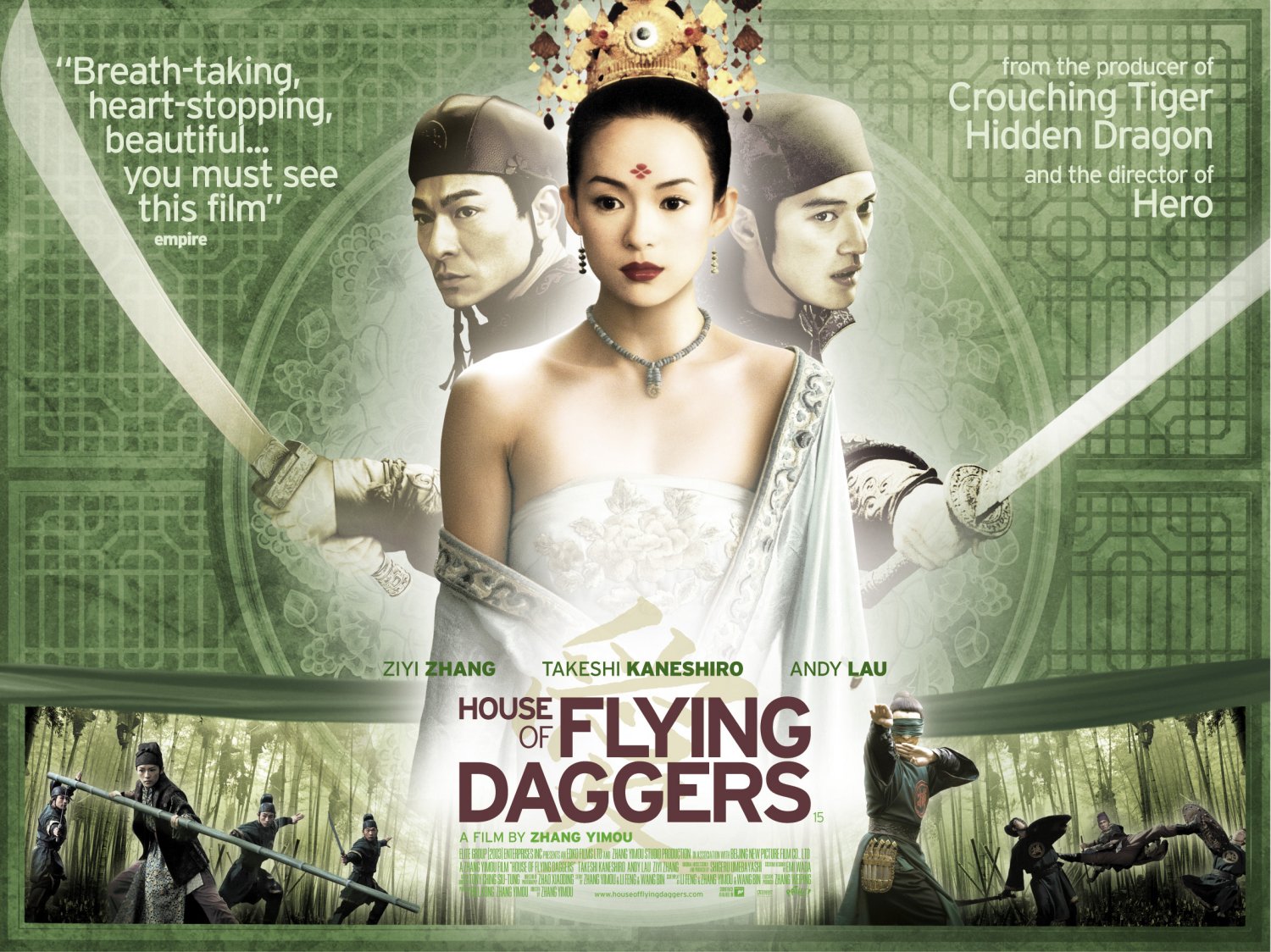
I've Just Seen: House of Flying Daggers (2004)
House of Flying Daggers (2004)

Director: Zhang Yimou
If you enjoyed Ang Lee's Crounching Tiger, Hidden Dragon, you are almost guaranteed to like House of Flying Daggers. Not only is its another wuxia film (though this time without the flying, despite the film's title), but its also stars Zhang Ziyi who was so brilliant in Crouching Tiger. Here she plays a blind dancer called Mei, who is believed to be the daughter of the leader of the outlawed group House of the Flying Daggers, who are battling the corrupt Tang Dynasty. She is arrested, then freed by Jin, who is acting as a double-agent, pretending to be sympathetic to the group's cause in order to infiltrate it. He falls in love with Mei, who seems to return his affections, while remaining weary of him.
This is one of the most visually stunning films I have seen, and if you can watch a Blu-ray copy (or even better, see it on a big screen), do so. Yimou uses colour to breathtaking effect; action scenes are set in autumnal orange forests, serenely green bamboo forests and the climatic encounter is staged as a blizzard turns everything white. The costumes are also eye-catching, particularly the robes Mei wears during her drum dance. The action sequences are as balletic and beautiful as the dance Mei performs early on, with each setpiece distinctive from the other.
This is a great film, both narratively and stylistically. It puts many Western action films to shame with its emphasis on the beauty of the images, especially the fight scenes, and its selective use of CGI; knives, arrows and beans are animated, but humans perform the action scenes. It is romantic, funny, intelligent, exciting, and incredibly gorgeous to look at.

Director: Zhang Yimou
If you enjoyed Ang Lee's Crounching Tiger, Hidden Dragon, you are almost guaranteed to like House of Flying Daggers. Not only is its another wuxia film (though this time without the flying, despite the film's title), but its also stars Zhang Ziyi who was so brilliant in Crouching Tiger. Here she plays a blind dancer called Mei, who is believed to be the daughter of the leader of the outlawed group House of the Flying Daggers, who are battling the corrupt Tang Dynasty. She is arrested, then freed by Jin, who is acting as a double-agent, pretending to be sympathetic to the group's cause in order to infiltrate it. He falls in love with Mei, who seems to return his affections, while remaining weary of him.
This is one of the most visually stunning films I have seen, and if you can watch a Blu-ray copy (or even better, see it on a big screen), do so. Yimou uses colour to breathtaking effect; action scenes are set in autumnal orange forests, serenely green bamboo forests and the climatic encounter is staged as a blizzard turns everything white. The costumes are also eye-catching, particularly the robes Mei wears during her drum dance. The action sequences are as balletic and beautiful as the dance Mei performs early on, with each setpiece distinctive from the other.
This is a great film, both narratively and stylistically. It puts many Western action films to shame with its emphasis on the beauty of the images, especially the fight scenes, and its selective use of CGI; knives, arrows and beans are animated, but humans perform the action scenes. It is romantic, funny, intelligent, exciting, and incredibly gorgeous to look at.
Saturday, 9 April 2016
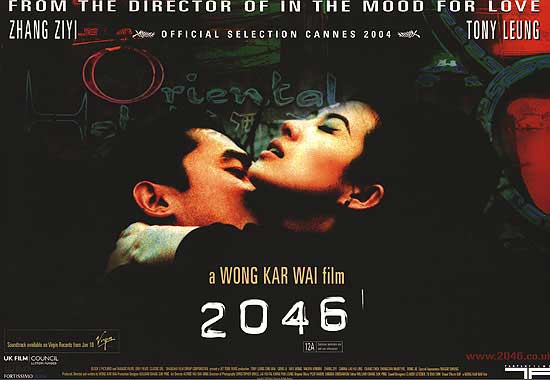
I've Just Seen: 2046 (2004)
2046 (2004)

Director: Wong Kar-wai
I love the aesthetics of the worlds Wong Kar-wai creates, filmed with an eye for colour and light that aids the romance of the characters. In the Mood for Love rivals Brief Encounter in its depiction of restrained, yearning unrequited love, and 2046 acts as a sequel to that story. We follow Chow Mo-wan after the dissipation of his affair with Su Li-zhen. He has left his wife, moved into a new apartment, and embarks on a series of affair with other women while also writing a science-fiction story set in the year 2046.
After the painful beauty and restraint of In the Mood for Love, 2046 is a bit of shock. It is louder and more explicit, with a timeline that jumps around in time and between Chow's fictional story and his real life. The brooding melancholy that is presence in so many of Kar-wai's films is present, but Chow's character feels less sympathetic than in the previous film. Everything still looks beautiful and I would watch Tony Leung Chiu-Wai in anything, but it suffers from comparison with In the Mood.
Worth a watch, but be prepared to have your ideas about the ending of In the Mood for Love completely dashed.

Director: Wong Kar-wai
I love the aesthetics of the worlds Wong Kar-wai creates, filmed with an eye for colour and light that aids the romance of the characters. In the Mood for Love rivals Brief Encounter in its depiction of restrained, yearning unrequited love, and 2046 acts as a sequel to that story. We follow Chow Mo-wan after the dissipation of his affair with Su Li-zhen. He has left his wife, moved into a new apartment, and embarks on a series of affair with other women while also writing a science-fiction story set in the year 2046.
After the painful beauty and restraint of In the Mood for Love, 2046 is a bit of shock. It is louder and more explicit, with a timeline that jumps around in time and between Chow's fictional story and his real life. The brooding melancholy that is presence in so many of Kar-wai's films is present, but Chow's character feels less sympathetic than in the previous film. Everything still looks beautiful and I would watch Tony Leung Chiu-Wai in anything, but it suffers from comparison with In the Mood.
Worth a watch, but be prepared to have your ideas about the ending of In the Mood for Love completely dashed.
Saturday, 12 September 2015
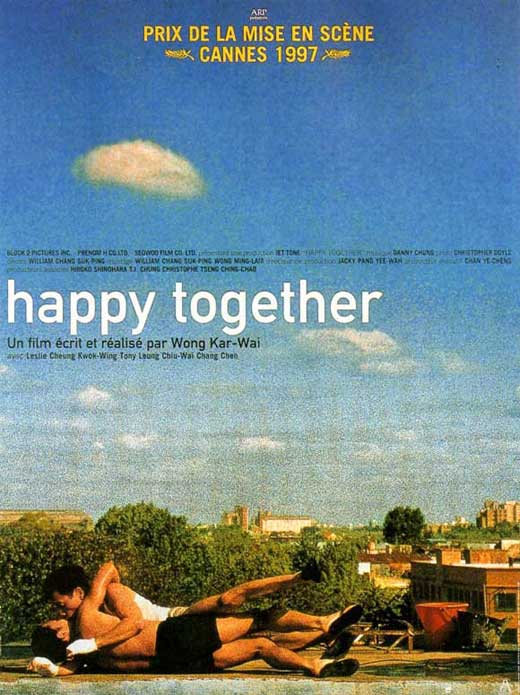
I've Just Seen: Happy Together (1997)
Happy Together (1997)

Director: Wong Kar-wai
I have really liked the films of Wong Kar-wai; he captures the intimacies and irritations of relationships, and tells stories that are quietly romantic and melancholic. Happy Together is another example of Kar-wai's talents. It portrays a highly strained relationship between Ho and Lai, who young men who are working in Argentina after spending all their money while there on holiday. They have an on-again off-again relationship, with Ho constantly leaving Lai, then coming back when he is desparate. It is Lai's perspective we follow, as he works to save money to go back to Hong Kong.
The film this reminded me of was Blue is the Warmest Colour. Not just because both films follow a same-sex couple, but because of the focus on the introverted character in the relationship. Lai and Adele live much of their stories in the shadow of their passionate relationship with the more outgoing Ho and Emma. We see them try to move on, but not really succeeding.
The title of Wong Kar-wai's film could be read as ironic; Ho and Lai verbally pick at each other so much that you wonder if they are ever truly happy. However, Wong Kar-wai himself said that the title could refer to Lai and his past, and being at peace with what has happened, allowing him to move forward and find love again. My interpretation was slightly different. While together they are volatile, we do see Ho and Lai happy together; the dance scene in the kitchen is one such moment. When they are apart neither is happy.
A great film from Wong Kar-wai, who is now one of my favourite filmmakers.

Director: Wong Kar-wai
I have really liked the films of Wong Kar-wai; he captures the intimacies and irritations of relationships, and tells stories that are quietly romantic and melancholic. Happy Together is another example of Kar-wai's talents. It portrays a highly strained relationship between Ho and Lai, who young men who are working in Argentina after spending all their money while there on holiday. They have an on-again off-again relationship, with Ho constantly leaving Lai, then coming back when he is desparate. It is Lai's perspective we follow, as he works to save money to go back to Hong Kong.
The film this reminded me of was Blue is the Warmest Colour. Not just because both films follow a same-sex couple, but because of the focus on the introverted character in the relationship. Lai and Adele live much of their stories in the shadow of their passionate relationship with the more outgoing Ho and Emma. We see them try to move on, but not really succeeding.
The title of Wong Kar-wai's film could be read as ironic; Ho and Lai verbally pick at each other so much that you wonder if they are ever truly happy. However, Wong Kar-wai himself said that the title could refer to Lai and his past, and being at peace with what has happened, allowing him to move forward and find love again. My interpretation was slightly different. While together they are volatile, we do see Ho and Lai happy together; the dance scene in the kitchen is one such moment. When they are apart neither is happy.
A great film from Wong Kar-wai, who is now one of my favourite filmmakers.
Subscribe to:
Posts (Atom)