Tuesday, 28 October 2014

Great Films: The Lady Eve (1941)


http://upload.wikimedia.org/wikipedia/en/thumb/f/f0/1941.lady.eve.jpg/220px-1941.lady.eve.jpg 


You see, Hopsy, you don't know very much about girls. The best ones aren't as good as you probably think they are and the bad ones aren't as bad. Not nearly as bad.”


Preston Sturges' The Lady Eve is one of my favourite films. This screwball comedy follows Jean Harrington (the luminous Barbara Stanwyck) and Charles 'Hopsy' Pike (an adorable Henry Fonda) as they fall in and out (and in) love with each other. Jean and her father are card sharps who decide to con the rich, naïve Charles, who has been up the Amazon for a year studying snakes. Jean and Charles fall in love, but he rejects her after discovering her deceptive behaviour. To teach him a lesson, Jean comes to his house posing as the English 'Lady Eve'. He falls for her (again), but discovers on their wedding night that Eve is not as sweet and innocent as he believes her to be. 


https://d2nh4f9cbhlobh.cloudfront.net/_uploads/galleries/33969/ladyeve1.jpeg

The plot sounds ridiculous, but I always see the plots of screwball comedies as part of the joke; it is not meant to be taken seriously. That being said, in The Lady Eve Sturges is being satirical on issues around gender politics and sexual hypocrisy. Critic David Parkinson, in his book History of Film, argues that Sturges made satires that 'ran contrary to traditional Hollywood values in exposing a range of American foibles'(94). 
 
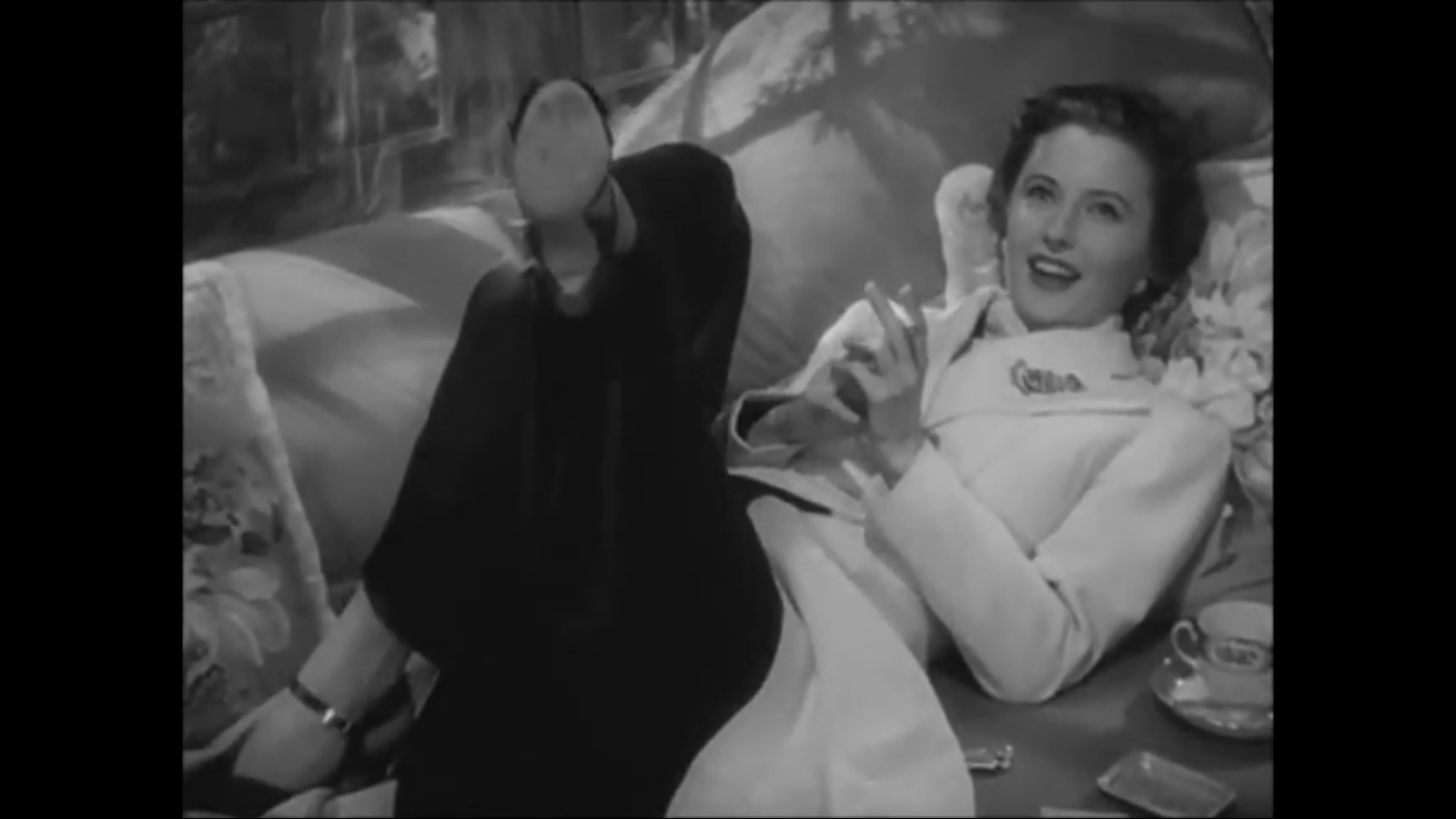
Charles, highly uneducated in regards to women, judges Jean in black-and-white terms, imagining that because she is a con artist, she did not really love him; that she is completely 'bad.' It is no mistake that Jean is wearing black the night Charles first meets her, or that Eve is decked out in white when she visits Charles' home: that is how Charles sees her/them. 
 
http://s3.amazonaws.com/criterion-production/images/2620-0372bef9aeb8a340be96c2d7c0a97b39/120_127_large.jpg
See anything you like?
 http://media-cache-ak0.pinimg.com/736x/9e/fc/60/9efc6078331c03fd449495665e3d74d4.jpg


But Jean/Eve also wears a mixture of blacks and whites as well as greys (or what appear as grey because of the Black-and-White film); she is far more complex than Charles realises. When Jean says that she think she's falling in love with Charles she remarks that 'I'm going to be exactly the way he thinks I am. The way he'd like me to be.' She is wearing white at the time, and wears white that night when he proposes to her. Wearing white as Eve is a nod to this desire to be what he wants her to be, but Jean is now using Charles' ideals against him. 
http://filmfanatic.org/reviews/wp-content/uploads/2011/12/Lady-Eve-Gown2.pnghttp://uselessmathematics.files.wordpress.com/2011/12/tumblr_lskdtq3cz91qcxbdxo1_500.png 


Sturges, who co-wrote the screenplay was Monckton Hoffe (great name!), litters the film with references to Adam and Eve in the Genesis story. The opening credits have a snake slithering around the titles who occasionally winks at the audience. There is also an apple or two. 

http://annyas.com/screenshots/images/1941/lady-eve-title-screenshot.jpg
Charles is an ophiologist and is travelling with a snake called Emma. One of the first things Jean does when she sees Charles get on the boat is drop an apple on his head. At dinner Charles reads the book Are Snakes Necessary? The most obvious is that Jean calls herself 'Eve' when in disguise.
 
http://upload.wikimedia.org/wikipedia/commons/9/93/Henry_Fonda_in_The_Lady_Eve_trailer.JPG 


Charles also falls over several times during the film, and all of those falls are because of Jean/ Eve. Of course, all screwball comedies have some kind of pratfall, but in The Lady Eve it is also an allusion to the 'fall of man', which we all know was the fault of Eve! 
https://blogger.googleusercontent.com/img/b/R29vZ2xl/AVvXsEinB4Ycv54OQ1YkZ08coW7lYPZhYU2xS-Kw8iK2HX0eqOZFxJohbFDYnJHLJ3POk9zrLsqBPNvW1x59jhNUCUb9U2qIqeQffsBU8ngFz9KFuCx6yLKfaZg1nxXymAcWzUm12XygsVY/s1600/Picture+2.png
Jean literally makes Charles fall for her.

In Christianity some Church Fathers interpreted the Genesis story in a rather misogynistic light, casting Eve as the temptress who lured Adam into his downfall. (I've read Genesis, it doesn't actually make any suggestions that way): man's fall is the fault of woman. It is related to the angel/whore dichotomy that still pervades modern thinking. Sturges and Hoffe use the Genesis story to comically point out the flaws of this approach to male/female relationships. Jean, as Eve, sets out to prove to Charles that most women are a mixture of 'good' and 'bad' (what ever that means); and attempts to read paradigms onto people often ends in disaster. 


http://theblondeatthefilm.files.wordpress.com/2014/02/theladyeve-fonda-stanwyck-cuddle-2.png
 
Of course, Jean is not really being altruistic: in the end, all she wants is for Charles to love her for who she is.

In my opinion, the best romantic comedies say something insightful about romantic relationships in a humorous way, usually looking at the power plays between genders. This is what makes The Lady Eve so great. That, and Stanwyck and Fonda.

What other rom-coms do something similar?

Tuesday, 14 October 2014

Double Feature: 2001: A Space Odyssey and Mulholland Drive


Warning: here be spoilers. (Though since I am still not entirely sure what Mulholland Drive was about, it is hard to spoil it).

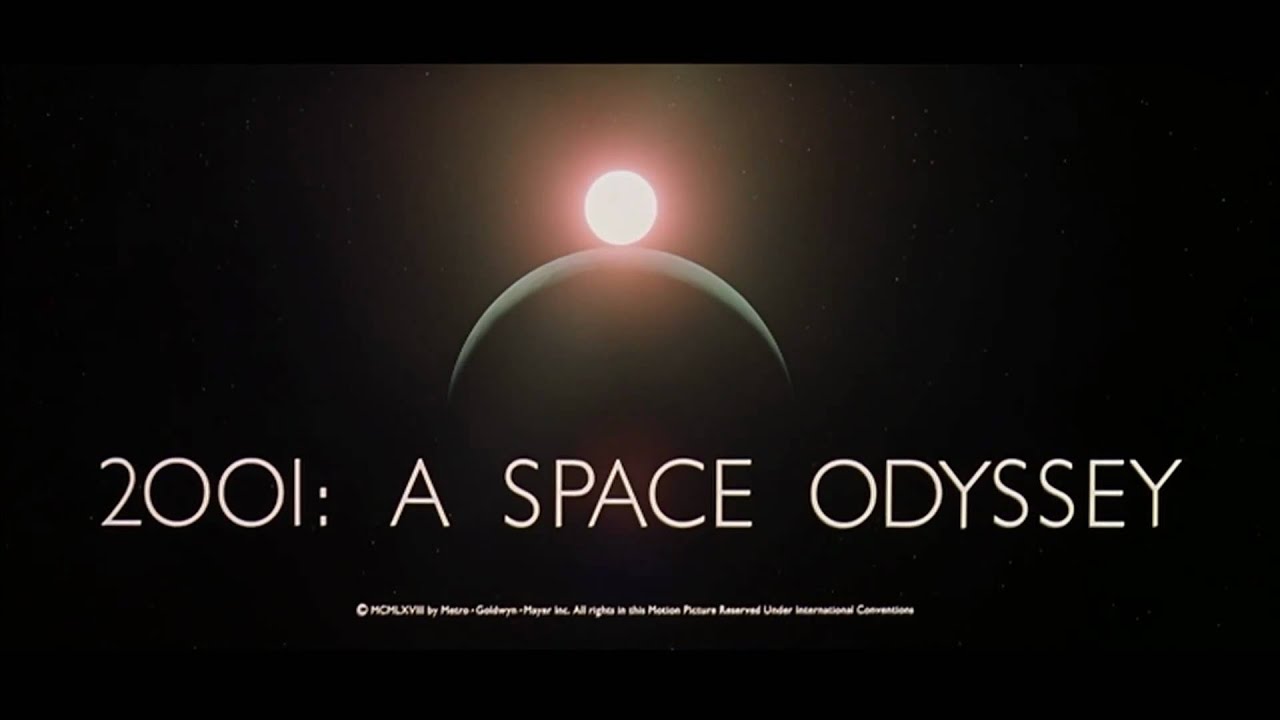
http://i.ytimg.com/vi/e-QFj59PON4/maxresdefault.jpghttp://images12.annyas.com/2001/mulholland-dr-title-screenshot.jpg


At first glance, Stanley Kubrick's 2001: A Space Odyssey (1968) and David Lynch's Mulholland Drive (2001) are not obviously similar. The first is a science fiction film that covers millions of years of human evolution (in a linear fashion), and explores issues around technology and extraterrestrial life. Lynch's film is a drama set in Hollywood, and is a mysterious neo-noir tale of dreams, reality, and identity. Kubrick's film is famously light on dialogue, while Lynch's film is full of elliptical conversations. However, both films are visually striking, and the story of each is propelled forward by a mystery.

The greatest similarity between 2001 and Mulholland Drive (and is what connected these two films in my mind) is the sudden change that happens at the end of the second act. These changes are triggered by mysterious objects which alter the reality of the previous action. In 2001 the monolith appears throughout the film, slowly influencing the progress of human evolution. Dark, opaque blocks of something, the monoliths have the ability to move around, and even communicate with each other, implying an inherent consciousness and intelligence (or that they are controlled by beings that possess these qualities).
http://momentumbooks.com.au/wp-content/uploads/2013/07/hotel-monolith.jpgAstronaut Dave Boorman, who is part of a space mission to Jupiter, encounters one of these monoliths orbiting the planet. It transports him through space and time. He then finds himself in an 18th century style room where he watches and experiences his own 'evolution,' as the ageing process is sped up, assumedly by the monolith. Boorman is re-born a Star-Child, a new, uncharted phase of life for humans.


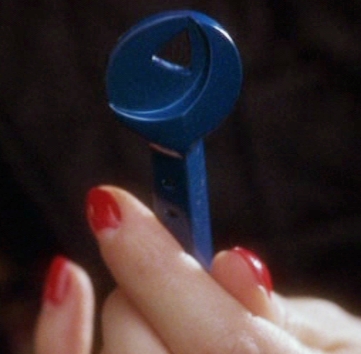
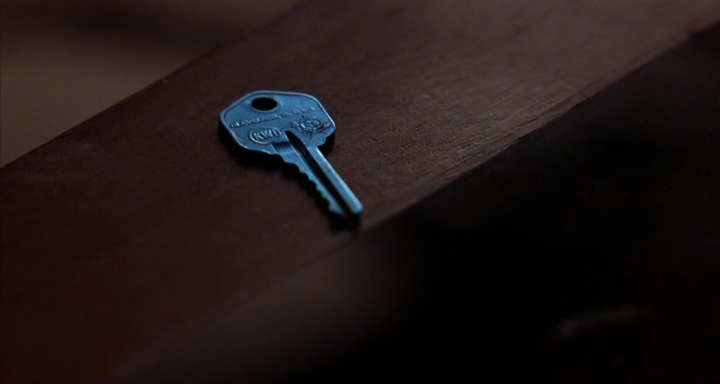
  In Mulholland Drive, early in the film, Betty and Rita discover a blue key in Rita's purse. There is no hint as to what it opens (nor does Rita remember why she has it). After a bizarre performance at a club called 'Silencio' Betty and Rita suddenly find a blue box in Betty's purse. How did it get there? Moments before Rita opens it with the key, Betty disappears from the room. Opening the box triggers a sudden change in the plot: the characters Betty and Rita change to Diane Selwyn and Camilla Rhodes respectively. Other characters from the film appear but all the relationships have changed; and places previously visited are visited again but have different emotions attached to them. A cafe that was the scene of dialogue about dreams is now where Diane (Betty) hires a hit man to kill Camilla (Rita). Another blue key is mentioned in this scene: the hit man says she will find it on the table when the hit is completed. 
 
http://fc09.deviantart.net/fs70/f/2013/033/7/a/sciifkey_by_albatrash-d5tjtez.jpghttp://films7.com/art/img/david_lynch_mulholland_drive_boite_bleue_blue_box.jpg 
http://www.tasteofcinema.com/wp-content/uploads/2014/06/mulholland-drive-blue-key.png
 
The mystery surrounding these two objects also connect the two films. In neither 2001 or Mulholland Drive is it explained where they come from. The monolith simply appears on earth in the first act, then another is uncovered on the Moon, another orbiting Jupiter, and it is the last thing that Dave Boorman sees as a human. One could assume that it is some type of alien life, but its motivation is not obvious. We also do not know if it is benign or malevolent. Perhaps it is simply a conduit for supremely evolved beings to influence other lifeforms. Who knows.

Because Rita is suffering from amnesia at the beginning of Mulholland Drive she cannot explain what the key is for. The mystery of the box's appearance in Betty's purse is also never explained. The second blue key that appears in the third act is somehow related, but again the 'how' is not obvious. As it is a key that unlocks a box, it is tempting to read them as a metaphor for Rita unlocking the truth of this world: that it is in fact 'untrue,' a fabrication. Is identity something we fabricate for ourselves? And if so, are our ideas about other people also creations, even acts of private storytelling?
  
Perhaps the strongest connection that these two movies have is that they are to be experienced rather than explained. Because of this, they stand up to multiple viewings as audiences try to decipher what they mean. (I will use this as an excuse if this post is hard to follow: it's the fault of the films, I tell you!).

Like many great films, 2001: A Space Odyssey and Mulholland Drive ask us questions about who we are as a collective group, and how we relate to each other within that group. The questions are not easy, nor do they necessarily prompt positive answers.

To be clear, I am not suggesting that you actually watch 2001: A Space Odyssey and Mulholland Drive back-to-back. I believe that would leave you mentally spent and highly confused. After both I needed time to absorb what I had seen (and occasionally heard). If you are the type of person who likes things neatly wrapped up at the end of your movies you will probably be mortally frustrated by them or rather bored.

If you have seen them, what other films did they remind you of?


Friday, 3 October 2014

Based On: Emma and Clueless

https://blogger.googleusercontent.com/img/b/R29vZ2xl/AVvXsEjZhxfP3DbEBupzrxXlk8xIm2mFFzHDs5hOnWMqSi01EJNnPycIJa_XeP4eVMdl_FCPsn6jqIdShrHKf7wEn4TXkdhEDimTSMaHBj29fYDzcUk41boqoLIVEXlY4GUU5r6UjC6LXWQH6Mk/s1600/emma.jpg[clueless-poster.jpeg]


Many filmmakers seem to throw out subtlety when they adapt the classics. Rather than presenting a reading of the source material, focusing on themes and character psychology, they go all out on the look of the film and neglect the story. Even if they do some of those things, it is hard to see past the costumes and wigs and horses and carriages, broody men in cravats, and rose-coloured nostalgia.

Nowhere is this more true than with Jane Austen's novels (which I love). I have always been interested in adaptations of the novel, but I rarely love them; and even those I have loved, like the BBC one from 1995, I have become a bit detached from. For me, most adaptations miss what I love about the novels: the humour and subtle satire. Instead they focus on the look of the period, and turn the stories into occasionally simpering, syrupy love stories that leave me highly unsatisfied. 

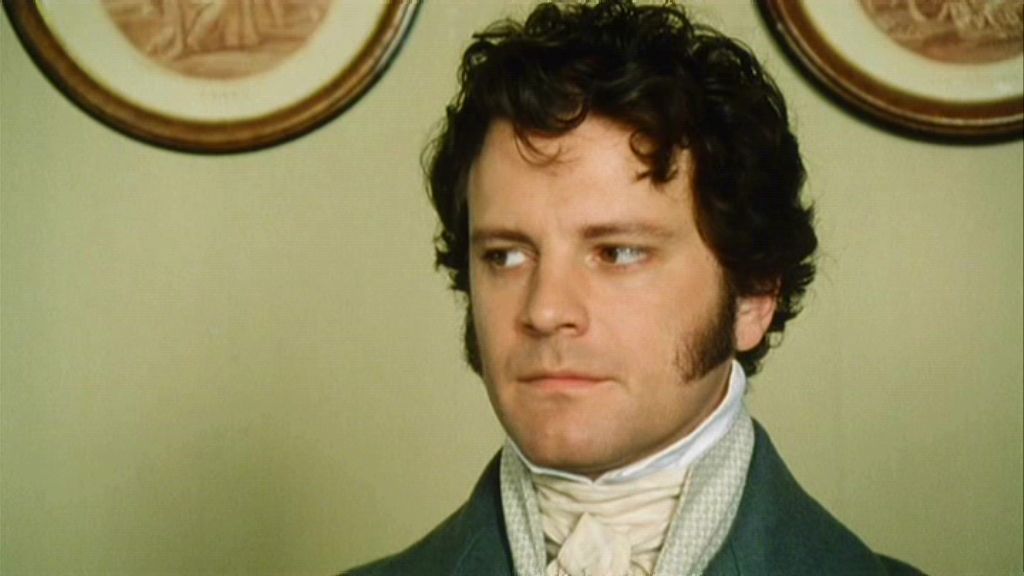
http://images.fanpop.com/images/image_uploads/Colin-in-Pride-and-Prejudice-colin-firth-567876_1024_576.jpg
Sorry Darcy.
  Amy Heckerling's Clueless knows what is so great about Austen's novels. It is based on Austen's 1815 Emma, which is about twenty-one year-old, snobbish match-maker Emma Woodhouse. It follows her as she befriends lowly Harriet Smith, flirts with Frank Churchill and frustrates her friend Mr Knightley. Throughout this she discovers harsh and surprising truths about herself and people around her. Clueless' Cher undergoes a similar transformative path to Emma in the film. She gives a makeover to new girl Tai, flirts with Christian, and frustrates her ex-step-brother Josh. She also has to face up to certain truths about herself, largely about her feelings towards Josh. 

http://static.parade.condenast.com/wp-content/uploads/2014/05/clueless-cast-where-are-they-now-ftr.jpg 
 
I contend that Clueless is the best adaptation of Emma so far. It takes Austen's satirical eye and applies to 1990s' youth culture. Both film and novel focus on overly confident young people living in contained communities: Highbury for Emma, the Valley and Bronson Alcott High School for Cher. Both Cher and Emma are the centre of sophistication in their societies, and wield quite a lot of power (though it is not always used wisely).

Emma and Clueless deal with contemporary issues and ideas; this is in contrast to most adaptations, which are modern reconstructions of the past. Austen focuses on issues surrounding marriage, and love, friendship and class, and self-knowledge for young Regency women; Heckerling explores ideas about love, sex, friendship and groups, and self-knowledge in 90s youth culture. This is what allows the satire to work. 

http://nativemobile.com/wordpress/wp-content/uploads/2014/08/Totally-Clueless-50-percent-of-Corporate-Execs-Cant-Measure-Social-Media-ROI.jpg

 
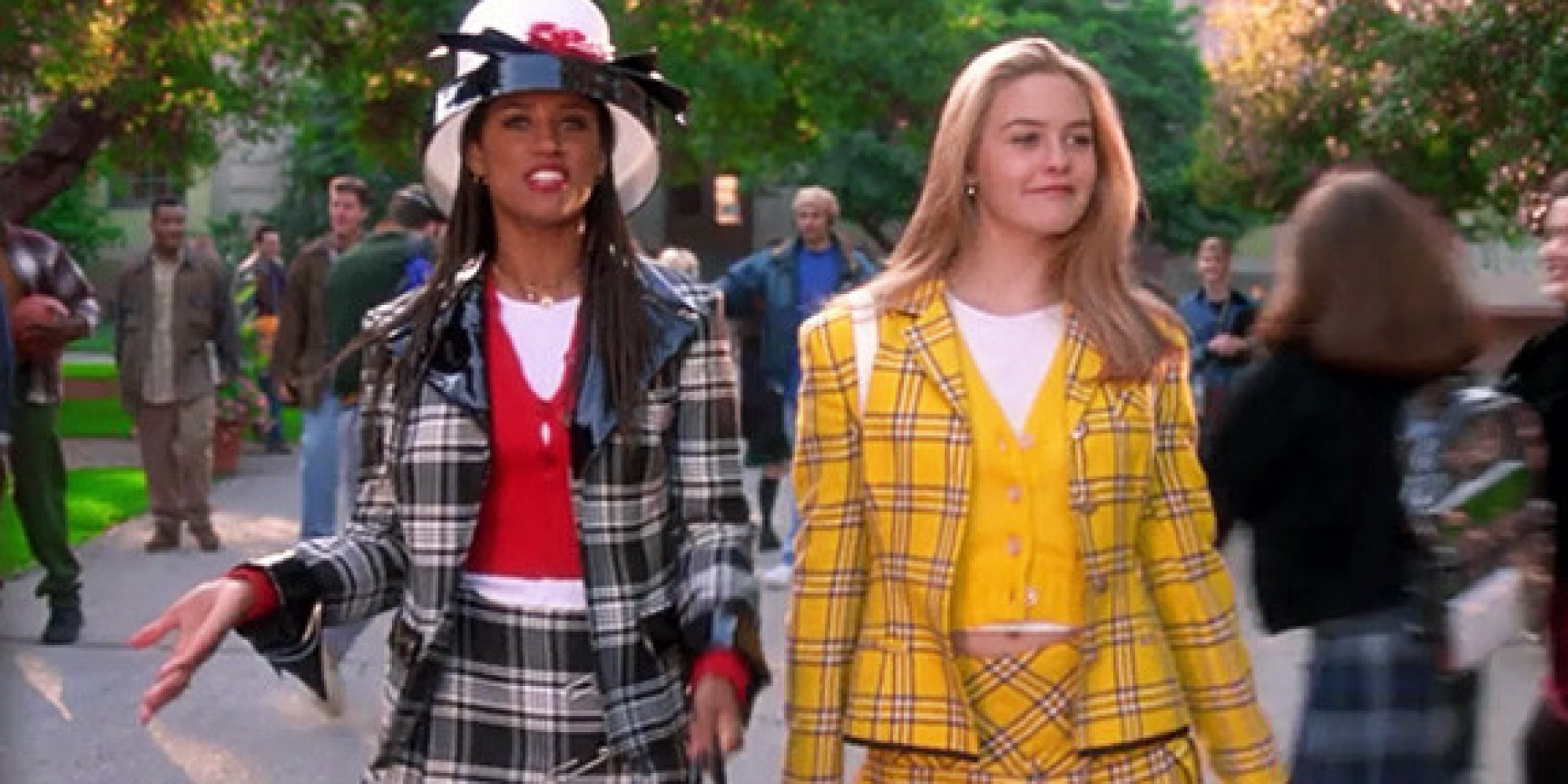
Heckerling cleverly uses costumes to accentuate her comedy. The first scene is Cher's extensive wardrobe, and her computer program that allows her to create her outfit for the day. But, as she tells us in voiceover, 'I actually have a way normal life for a teenage girl.' Her clothes are highly fashionable, too fashionable to wear to school; in her rather iconic yellow suit Cher looks like she has walked out of a commercial. Cher's friend Dionne is the same. 
 

http://i.huffpost.com/gen/1374654/thumbs/o-CLUELESS-facebook.jpg 


http://images6.fanpop.com/image/photos/33900000/cher-clueless-33982176-1600-900.jpg
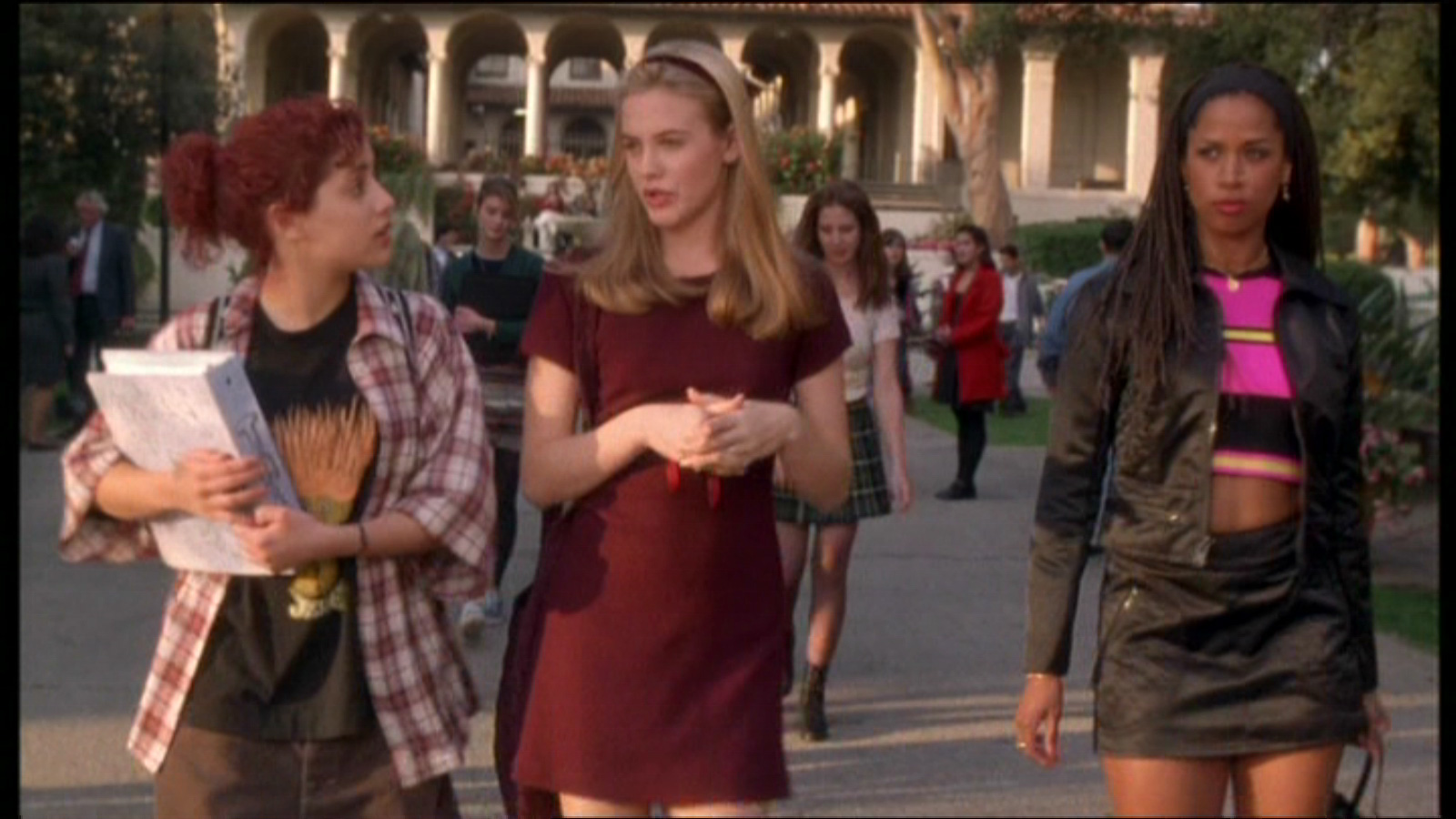
The costumes are also used to distinguish the different cliques or 'classes' within the school group, much like the mixture of classes in Emma. Tai, the new student, looks like a 'farmer' in her plaid shirt, and is obviously not as wealthy as Cher. Amber is a cheaper version of Cher, and her clothes are far more tacky. Murray, Dionne's boyfriend, wears a street style. Everyone is aware of these differences, Cher in particular. She says

'So, OK. I don't wanna be a traitor to my generation and all, but I don't get how guys dress today. I mean, c'mon, it looks like they just fell out of bed and put on some baggy pants, and take their greasy hair—ew!—and cover it up with a backwards cap and, like, we're expected to swoon? I don't think so!'

http://fora.mtv.ca/wp-content/uploads/2012/06/clueless-11.jpg
 
This mixture of different cliques is comparable to the mixture of differing classes in Austen's novel. Wealthy Emma associates with her old governess Mrs Weston, parentless, poor Harriet and Miss Bates, who has slipped into poverty. Many of the novel's tensions come from these relationships, and some of Austen's satire is around the interaction of the different classes, and how her heroine reacts to them (largely in comparison to Mr Knightley). Josh, the Knightley character, is above this world, being a college student. He constantly makes fun of Cher's insular world, much the same way that Knightley tries to tell Emma that there is more to the world than Highbury. 
 
Clueless is a very funny film with a witty and sharp script. The audience is guided throughout the film by Cher in voiceover, who dishes out wise advice and observations about being a teenager:
http://edition.cnn.com/SHOWBIZ/Movies/clueless/clueless.gif
'Anything you can do to draw attention to your mouth is good. Also, sometimes you have to show a little skin. This reminds guys of being naked, and then they think of sex.'

Heckerling also captured Valspeak with a liberal peppering of 'As if!' throughout, along with Alicia Silverstone's performance with its high rising inflections. The dialogue is also wonderful and highly quotable.
Tai: 'Why am I even listening to you to begin with? You're a virgin who can't drive.'
Cher: 'That was way harsh, Tai.'

Murray: 'He's a disco-dancing, Oscar Wilde-reading, Streisand ticket-holding friend of Dorothy, know what I'm saying.'

And my personal favourite:
https://blogger.googleusercontent.com/img/b/R29vZ2xl/AVvXsEg2XkJfDrvohs_Hmygo35f-lC-F_D0T_hjbqYKR20nK5db6yzez5cJhSGV78XE7yq6S-A7eb24AzAUXQrcOQj4Xah0hfAd833DnugWbC_VZZqxcDLN4LDiL05oi5fsnt0W-0Qw91BIpCp8/s640/I'm+not+prude+I%27m+just+highly+selective.jpg

Dionne: 'Cher is saving herself for Luke Perry.'
Tai: 'Cher, you're a virgin?!'
Cher: 'God! You say it like it's a bad thing.'
Dionne: 'Besides, the PC term is "hymenally challenged."'


Cher: 'I am just not interested in doing it until I find the right person. You see how picky I am about my shoes and they only go on my feet.'

The film is slightly self-reflexive in its depiction of teenagers engagement with the classics. Cher mentions Shakespeare twice during the film, first quoting sonnet 18 ('Shall I compare thee') from 'Cliff's Notes'; and then corrects some on a quote from Hamlet ('Well I remember Mel Gibson accurately'). Many teenagers experience the classics through the prism of pop culture, and for many Clueless is their first experience of Austen's Emma. Heckerling is clearly aware of this, and plays it for laughs. 

  To call this film the best adaptation of Emma is high praise from me, being a massive Austen fan. It takes Austen's gently satirical approach to teen movies, and injects wit into them. These young people may not be classically literate, but they are not stupid. In Australia several years ago (and it may still be the case) Emma and Clueless was an option for the comparative literature section of final leaving exams. I did not get to do it, much to my chagrin, so this post is largely me getting all of this off my chest. 
  
Do you think this is a good adaptation? 

http://amongthenarcissi.com/wp-content/uploads/2012/10/cher-clueless-as-if.jpg

Wednesday, 17 September 2014

Vale Margaret and David


It is always hard when a favourite television show ends. The characters have become part of your life, you think of them as friends. You know their quirks, their likes and dislikes, and you are attached to their relationships to each other. Knowing you will never seeing them do anything new again is sad. 

http://resources3.news.com.au/images/2012/05/23/1226352/894743-stratton-for-top-50.jpg


Yesterday, Australia's most famous film critics, Margaret Pomeranz and David Stratton, announced that their 28-year partnership would finish at the end of this year; they are retiring. For those of you outside of Australia, Margaret and David are very similar to Gene Siskel and Roger Ebert; they have a television show called At the Movies where they review the week's releases, each giving a rating out of 5-stars. Before At the Movies, which has been running for 10 years, they had The Movie Show on another channel that ran for 18 years. 

https://62e528761d0685343e1c-f3d1b99a743ffa4142d9d7f1978d9686.ssl.cf2.rackcdn.com/files/59106/area14mp/6rbyxgzs-1410842455.png
 
They are famous for their inability to agree, though they do not disagree nearly as much as people think they do; they are more likely to like or dislike a film for different reasons. But when they do disagree, it is a joy to watch! Cries of 'Oh Margaret' and 'Oh David' would be traded between the chairs, though it always stopped short of insult. In recent years they added a segment where they would pick a classic and explain why it was so wonderful. These classics are international and Australian classics, and it is rare that they disagree with the choice.

Like any movie-lover, they have their bugbears. David absolutely hates 'shaky-cam,' while Margaret is rarely taken with animation (though she loved the Toy Story series). David also deeply dislikes Lars von Trier. When Melancholia came out Margaret gave it 5 stars, while David could only manage 2.5. 

http://www.limelightmagazine.com.au/sites/www.limelightmagazine.com.au/files/Events/margaret-and-david.jpg
 
They are incredibly supportive of the Australian film industry, encouraging audiences to embrace local productions and get over 'cultural cringe.' They both gave Samson and Delilah (2009) 5 stars, calling it 'one of the most wonderful films this country has ever produced.' David even praised the handheld camera work, calling it 'an absolute object lesson' in how to use it. The affection for them is so great, and they are so well-respected that for their 25th year together, they had a special show where Cate Blanchett and Geoffrey Rush hosted, and played them. 

 
Personally, they are one of the reasons I love films so much. I started watching them around 2005, and have absorbed their focus on all aspects of filmmaking. They always make mention of the screenplay, the cinematography, the direction, the director's background, films in a similar vein to the one being discussed; and they have done so with passion and enthusiasm. They were the first to teach me that cinema can be art as well as entertainment, and that the best films are usually both. 

http://images-2.domain.com.au/2011/10/14/2691537/AS353atthemovies_20111014135740712145-200x0.jpg
Double acts don't come much better!
 

Monday, 15 September 2014

Based On: A Clockwork Orange

http://www.socialbookshelves.com/wp-content/uploads/2013/07/clock-work-orange-book.jpeghttp://gdb.rferl.org/A637410D-13EE-4233-B017-1AF8C2F382BA_mw800_s.jpg


Stanley Kubrick's film (from 1971) is a perfect example of a film adaptation that complements the source material. Anthony Burgess' novel is a vividly described story of 15-year-old Alex and his ultraviolent escapades with his droogs. After one particular incident results in a woman's death, Alex is sent to prison, where after two years he undegoes a new radical therapy, the Ludovico Technique, that will get him released in a fortnight. But what price is his freedom? Is he really free?

Kubrick's films follows the novel's plot quite closely, and asks the same questions regarding authority and government against the rights of the individual, and how the ability to make choices rests at the heart of what it means to be human. The greatest deviation from the novel's plot is the final chapter, which is completely left out. This is because the American edition of A Clockwork Orange thought it too sentimental and exorcised it, much to Burgess' chagrin.

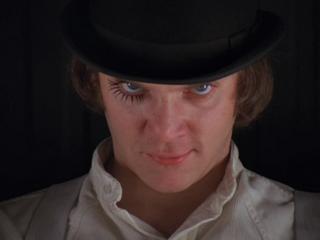
The last chapter alters the trajectory of Alex's character significantly (if you are squeamish about spoilers, you should know better than to read analyses of films and books you haven't experienced!). In the film Alex is 'cured' of his negatively reinforced moral behaviour, leaving the audience with a stare similar to the one we were welcomed with in the film's first frame. In the novel, Alex begins to yearn for a different life, and envisages having a wife and baby son. 

http://content.internetvideoarchive.com/content/photos/7239/30405805_.jpg
http://i.ytimg.com/vi/IgZgPTsJeHc/maxresdefault.jpg 


Which ending is better? In my opinion, neither. Though the book may feel slightly too neat, it does show growth and change in Alex's character. Remember, he is 15 at the novel's beginning; he appears to be going through a rebellious stage, and is yet to mature. Film Alex is back to the way he was at the beginning, implying his two-year ordeal has not fundamentally altered him at all. However, film Alex appears to be a few years older than book Alex, maybe seventeen, so perhaps his is too set in his ways. And he does have a clearly defined idea to rebel against: the government, and the cruelty of society he experienced after prison. Why choose to be better when no one else does?

Burgess' novel is told in the first person, and Kubrick keeps that element with Alex providing a voiceover throughout. As in the novel, Alex frequently address the audience with 'O my Brothers,' drawing us to side and sympathise with him. Malcolm McDowell is brilliant in the role. Despite being in his late twenties at the time, he infuses Alex with a youthful exuberance and charisma that endears him to the audience. This is ultimately what makes the film work. Without it, we would be glad that such a violent individual is spiritually castrated; with it we empathise with his situation. 

A Clockwork Orange

'It's not fair! It's not fair that I should feel sick when I hear lovely, lovely Ludwig Van!'

Film has the upper hand over books in its ability to incorporate other art forms into its medium. You can show them or play them, along with the characters reactions; a novel only gives us reactions. In A Clockwork Orange music plays an integral role in the story, and throughout is associated with torture. Alex loves classic music, and its association with the sickness during the Ludovico Technique is the most devastating aspect for him. In the novel all music is ruined for him; in the film only the '9th' (Beethoven's 9th Symphony) is associated with the sickness.

Kubrick litters classical music throughout his film, but it is not always rendered 'purely.' During the famous Ludovico Technique scene where 'Ludwig Van' is playing over the images, we the audience hear it played, but it is on an electronic instrument. I found myself hearing parts that I recognised, but could not get the flow of piece in my head. The effect is deliberately unsettling. We do not get the full blast of the piece until later, when Alex is being tortured by the author. 

http://www.dvdizzy.com/images/h-k/kubrick-27.jpg

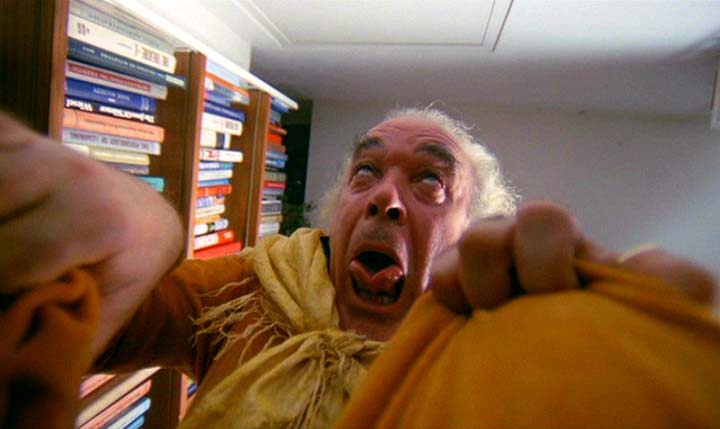
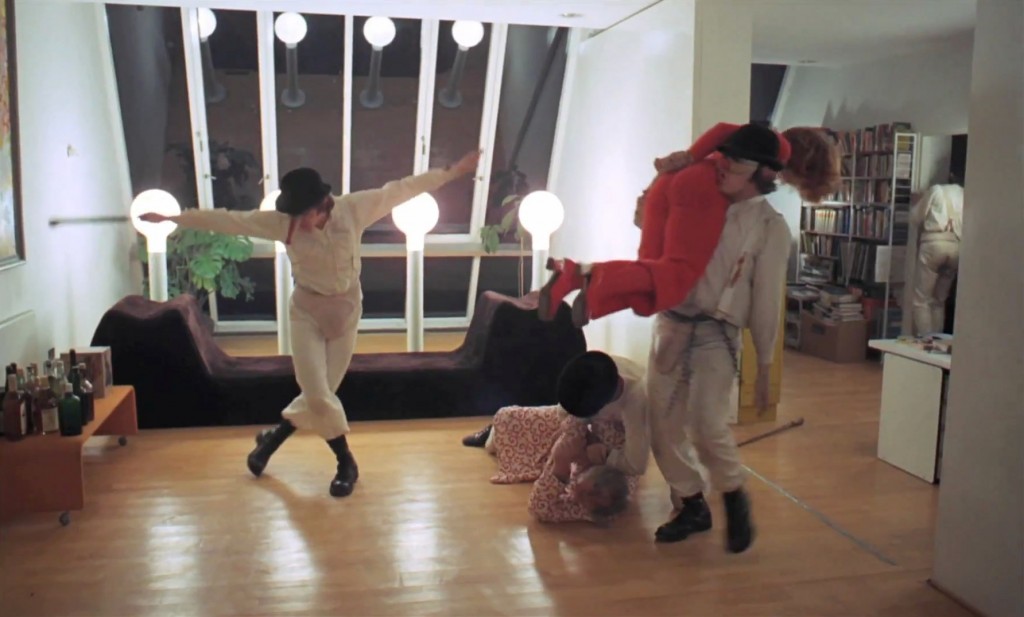
The author's torture of Alex is payback for an earlier dose of ultraviolence Alex had served the man and his wife in the story; Alex and his droogs beat the man and rape his wife in front of him. In the film Alex sings 'Singin' in the Rain,' kicking the man to the beat of the song. Later in the film, in a move similar to Peter Lorre's whistling in Fritz Lang's M, Alex sings the song whilst relaxing in the author's bath. The author, like Alex with the '9th', has a negative association with the song, and he loses all sympathy for Alex's plight. 
http://images.fanpop.com/images/image_uploads/A-Clockwork-Orange-a-clockwork-orange-323604_720_429.jpg

 
Kubrick and Malcolm McDowell's use of 'Singin' in the Rain' has a similar effect on the viewer as it does on the author from the story. Now when I hear the song, I get a strange mixture of Gene Kelly and A Clockwork Orange in my head.

http://upload.wikimedia.org/wikipedia/en/7/7d/Singin_Rain.jpg
 http://moviemezzanine.com/wp-content/uploads/clockwork-2-1024x617.jpg


The film and book of A Clockwork Orange are great companion pieces, each enhancing the other. With the novel, you have the full onslaught of Nadsat, a remarkable invention by Anthony Burgess. With the film, you have the music which will forever be associated with the stunning visuals of Kubrick's film.

Tuesday, 2 September 2014

Great Rom-Coms: When Harry Met Sally

The rom-com is one of the most despised genres of film. The mediocre or bad ones have derision heaped upon them. Their utterly predictable outcome is bemoaned by many; what's the point of watching the film if you know how it will end up? And do not forget the unrealistic expectations it gives people about relationships!

For me, the second point is rather ridiculous: most people are not silly enough to believe that films represent actual life. And while predictability is sometimes problematic, it is not only restricted to this genre of film (in fact most genres are guilty of this because of the very nature of genre). So why is the rom-com often singled out?

Without putting forward a rather sexist response, I can't answer that question. Instead I'm going to talk about the rom-coms I think are great, brilliant, wonderful, perfect, all the superlatives you can think of, and why. First up, one of my absolute favourites:
http://chuckyg.com/lists/movies/titles/when-harry-met-sally-1989.png


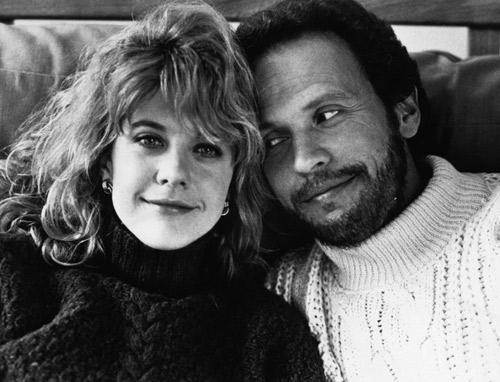
When Harry Met Sally (1989) details the relationship between Harry and Sally, moving from the first time they meet, when they didn't like each (or at least one of them didn't), to their friendship that eventually tumbles into love. This happens over the space of 12 years (and 3 months!).

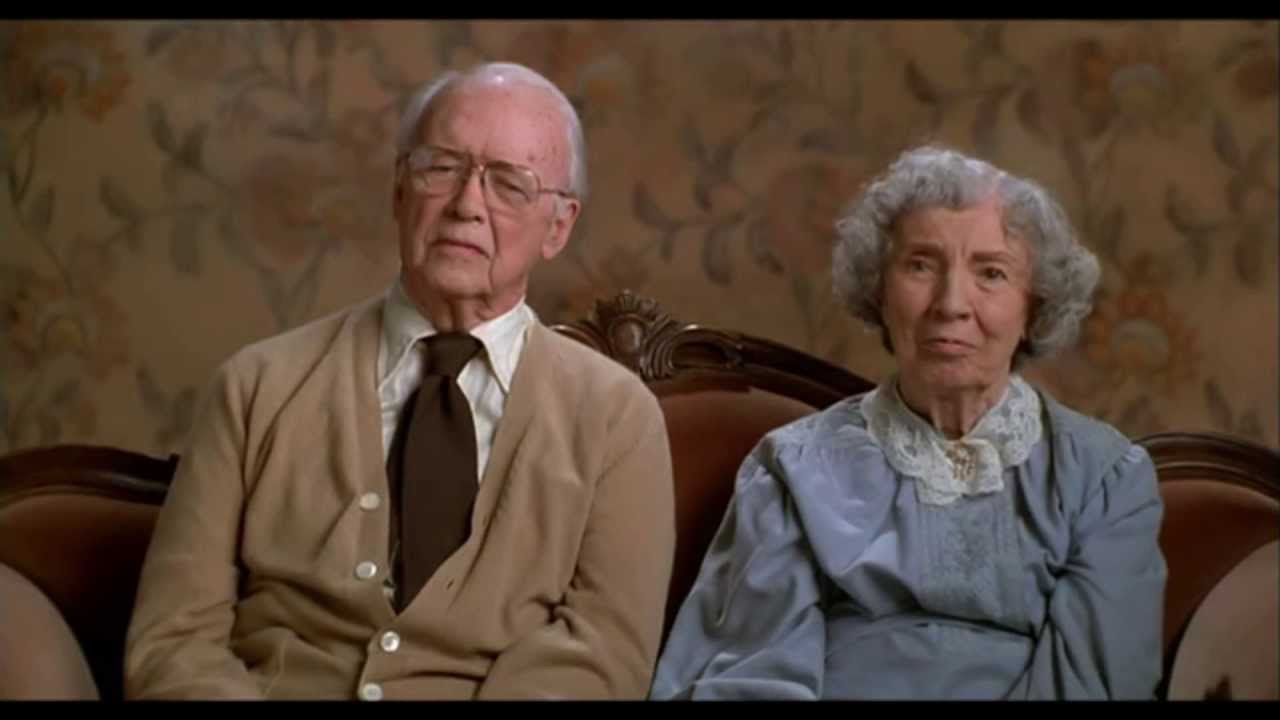
Though the main plot is linear, there are two things that are different from most rom-coms Hollywood produces. Peppered throughout the film are 'interviews' with older couples talking about how they met. These characters are not involved in the main plot, and have no tangible connection to the characters. But they are connected thematically, contextualising Harry and Sally's story within the multitude of other couples' experiences. This is not meant to be a representation of how all relationships are, but just one of many different stories that could be told. 
http://i.ytimg.com/vi/lzi2G68CMiE/maxresdefault.jpg
 
These stories do reveal the ending to us, for all the couples are married and many have been together for many years. It is implied that is the result for Harry and Sally. But we don't know the unique story of how they got there. 

http://moviesofhollywood.com/wp-content/uploads/2014/02/when-harry-met-sally-couple-valentines-day-couple.jpg

 
The second difference is a bit more subtle. The plot plays out in chronological order, but there are gaps in the actual timeline. Between the drive to New York and seeing each other at the airport, five years pass; after that five more years pass before they actually start getting to know each other properly.

Coincidence plays a large part in their relationship. 'Destiny', that old rom-com staple, is not what compels them together; they hardly think of each other in the intervening periods. And, although genre conventions dictate that people who start off hating each other come to like each other, those films are rarely set over such a long period of time, and thus the transition feels forced. When Harry Met Sally allows the characters to change in a more natural way, and are influenced by factors other than each other.

Dialogue is incredibly important for films about relationships, and this film has some of the best lines in film history. Of course, everyone knows the (in)famous 'I'll have what she's having,' but there are many Nora Ephron gems in this script. 'Baby fish mouth' is a hilarious moment, and for me is now a saying; Sally's deadpan 'It's amazing, you look like a normal person, but actually you are the angel of death' is fabulous. Most of Harry and Sally's exchanges are wonderful, but the films declaration of love is perfection:

Harry: I love that you get cold when it's 71 degrees out. I love that it takes you an hour and a half to order a sandwich. I love that you get a little crinkle above your nose when you're looking at me like I'm nuts. I love that after I spend the day with you, I can still smell your perfume on my clothes. And I love that you are the last person I want to talk to before I go to sleep at night. And it's not because I'm lonely, and it's not because it's New Year's Eve. I came here tonight because when you realize you want to spend the rest of your life with somebody, you want the rest of your life to start as soon as possible.

Sally: You see, that is just like you Harry. You say things like that and you make it impossible for me to hate you! And I hate you Harry, I really hate you …. I hate you.

 
  Great dialogue is all well and good, but Ephron also wrote great characters. Harry and Sally are not bland stereotypes; Sally may be high maintenance, but she is not a shrill, demanding person. Harry is at times cavalier in his relationships with women, but he is also coming to terms with a painful divorce, which has understandably rattled his approach to commitment. They also have small quirks particular to them: Sally orders food in such detail that I assume it often comes seasoned with spit (not on the side!), while Harry reads the last page of the books he reads just in case he dies before the end. These don't affect the plot, but they help flesh out these characters.

The supporting characters are just as well-drawn. Jess and Marie, Harry and Sally's respective best friends, could almost have a film of their own. They are not simply there to offer advice to Harry and Sally but have their own story arc, which involves falling in love and marrying each other, all in the time it takes Harry and Sally to figure out how they feel for each other.

One cannot talk about this film without mentioning its huge debt to Woody Allen's films. I saw this before I saw any of Allen's films, and when I watched Annie Hall I was struck by the similarities: set in New York, smart-talking characters; Sally reminded me of Annie, Harry had aspects of Alvy. This is in no way a bad thing; Allen's rom-coms are some of the best out there, and if you are going to be a bit derivative, take from the best!

It is interesting to note that the film was originally going to end with Harry and Sally not getting together, an ending which some like Rob Reiner, Nora Ephron and Carrie Fisher have said would be more realistic. They may be right, but this approach takes me back to the 'unrealistic' tag thrown at many rom-coms. The film is not a definitive answer to the question 'Can men and women just be friends?' but an exploration of that tension. As the couples show us, everyone's story is different, so an attempt at 'truth' is rather irrelevant.

http://images.amcnetworks.com/sundancechannel.com/wp-content/uploads/2012/09/when_harry_met_sally.jpg
I first watched this when I was fifteen and I have loved it since. It is not just a great romantic comedy, it's a great, brilliant, wonderful and yes, perfect movie. 
 

Thursday, 28 August 2014

Based On: Rashomon


'Based On' will be posts about book to film adaptations. If I am not too lazy they will become a regular feature. Warning: sometimes the book's plot is slightly different from the film, and if you don't want it spoiled for you, do not read this post (I mean that in the nicest way). First up:

Ryunosuke Akutagawa's 'Rashomon' and 'In a Bamboo Grove'; and Akira Kurosawa's Rashomon

Akira Kurosawa's Rashomon (1950) is a cinema classic based on two short stories by Japanese author Ryunosuke Akutagawa: 'Rashomon' and 'In a Bamboo Grove.'

Rashomon is the gate of Kyoto, a city which has recently undergone a several severe calamities. A young servant with a festering pimple on his cheek is sitting under the gate taking refuge from the persistent rain. He decides to become a thief in order to survive. He has an encounter with an old woman who is plucking hair from corpses in order to make wigs to sell.

'In a Bamboo Grove' presents seven separate testimonies and confessions relating to circumstances surrounding the death of a man in a bamboo grove (what a surprise). Four of these are different versions of the events in the grove, and the reader learns very quickly that no one is telling the exact truth.

If you have seen Kurosawa's film you will have noticed that the screenwriters stuck very closely to 'In a Bamboo Grove.' So why call it Rashomon?

The film keeps the torrential rain from 'Rashomon' but has three disparate people, a woodcutter, a priest and a commoner, take shelter underneath the Rashomon. The commoner retains some of the servant's characteristics from the short story: near the end of the film he steals trinkets from a baby abandoned at gate. He also berates the woodcutter, who may have inadvertently killed the dead man, for being a hypocrite.

In the short story the servant is morally disgusted at the sight of the old woman plucking corpses' hair, but she attempts to justify it, explaining that she had known the dead person, and they had sold dodgy fish to survive when alive. The old woman says 'I think she'd understand what I'm doing to her.' (8) The servant responds by stealing the old woman's clothes, and before he runs off into the night replies 'That's what I have to do to keep from starving to death.'(9)

This world that Agutagawa presents is clearly an amoral one, and for the majority of Kurosawa's film the audience is presented with the same world. People will do anything to protect themselves: lie, cheat, steal.

Ryunosuke Agutagawa committed suicide at thirty-five, and spent much of his life fearing he would suffer from mental illness like his mother. This partially explains his pessimistic view of human behaviour, a view which leaves a reader without a morally upright character to lean on.

Kurosawa's film ends quite differently. The baby, as babies often do, stands as a symbol of hope for the future. It acts as a reprieve for the woodcutter, who tells the priest that he will look after it, as he has six other children at home; it is a place is will be cared for and loved. The film's final shot is the woodcutter walking home with the baby. He is able to go home because the rain has stopped; his way is now clear.

Kurosawa and the screenwriters could have chosen to tell only the story of 'In a Bamboo Grove.' It is a very clever story but it the audience leaves mistrusting the characters. The reason for the more uplifting ending is likely to lie with the historical context of the film.

It is five years after World War II, and we all know Japan had suffered and inflicted lots of pain in that war. People would have felt that society was in a decay similar to the decay represented by the flooding rain at the film's beginning. The positivity about the future at the end, with the passing of the rain and the return of sunshine reminded the viewer that just like climate with its changing seasons, the world goes through decay and re-growth.

If you haven't read Agutagawa's short stories I would highly recommend doing so. It is interesting to note that Kurosawa's Rashomon is not technically a 'faithful' adaptation of its source material, and a good argument against that approach to book-to-film adaptations.