Showing posts with label Soviet Cinema. Show all posts

Wednesday, 11 January 2017

I've Just Seen: Ivan's Childhood (1962)

 Director: Andrei Tarkovsky

For such a small filmography, Tarkovsky managed to make all the films he made count. Of his eight full length films, four feature on the 1001+ list; the only reason I can account for Ivan's Childhood's absence is that the list is only meant to give you a taste of a director's output. The story follows a young boy called Ivan, during World War II in Russia. He has become involved in army work after the death of the rest of his family.

This was Tarkovsky's first full length film, and few director have emerged so wonderfully developed. The story is filled with flashbacks and dream sequences (and sometimes it is hard to tell the difference), yet they slip into the modern story well, enhancing the nightmarish quality of the setting. The cinematography is beautiful. The film is set in darkened rooms and swamps (and one memorable scene in a forest), and the black-and-white stock emphasises the dankness of war-torn Russia.

This is arguably Tarkovsky's most accessible film, with a setting and emotions that are understandable, and have been tackled in films before. Yet it also gives you a flavour of this daring director who interrogated the Soviet Union and Russia's past. As in other Tarkovsky films, characters are at the forefront, yet perhaps because Ivan is a child, his motivations are clearer to us. We find ourselves immersed in this very adult world through the perspective of a child who has seen horrible things, yet who also retains an innocent naivety about the power he has. The last scene of the film is a tragic reminder the lost childhoods of many children as a result of war, sadly something still relevant today.

Saturday, 6 June 2015

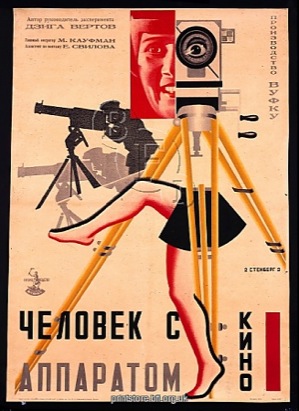
I've Just Seen: The Man With the Movie Camera (1929)

The Man With the Movie Camera (1929)

http://www.austinchronicle.com/imager/b/original/1345273/d4fa/scaled.poster_for_dziga_vertovs_man_with_a_movie_camera_1928_4172313.jpg

Director: Dziga Vertov
Writer: Dziga Vertov

I love watching films from the early years of cinema. Some of the most experimental films in the form's history date from this period; The Man With the Movie Camera is one of these. I found it utterly delightful. I must confess I didn't really clock the Marxist aspects of the film, which, considering the amount of vision of machinery efficiently working away, accompanied by images of happy, busy people exposes my sloppy viewing. However, this does show that The Man With the Movie Camera is enjoyable without engaging with its politics.

The film's self-reflexivity is one of its most charming aspects. We start with a cinema theatre filling up with an audience, welcomed by magical chairs that unfold invitingly. There are also several 'over-the-shoulder' shots of the camera filming the bustling city, and a lovely little sequence where the camera assembles itself and walks around.

The subject of this documentary is the cities of Moscow, Kharkiv, Kiev and Odessa and their residents, going about their daily lives. We see them rise in the morning, blinking their eyes against the sunlight like blinds on a window; going up buildings in lifts, and across town in trams. The tone is upbeat and celebratory, presenting the world of the everyday worker and their enjoyment of all aspects of life.

The film techniques employed by Vertov are many, and for me were not used as a gimmick. Vertov used double exposure to overlay an image of machinery with a a smiling female worker (how Marxist!); his tracking shots followed moving vehicles and (self-reflexively) his own camera perched on an open tram cart, immersing the viewer in the movement of the city.

This is a gorgeous documentary, one of the best in cinema history.