Showing posts with label Fantasy. Show all posts

Friday, 27 October 2017

I've Just Seen: Westworld (1973)

Director: Michael Crichton

Science-fiction and Westerns genre mash-ups often make curious films. Science-fiction is usually focused on the future and technologies interacting with humans; Westerns almost invariably look to the past, and humans in a more primitive mode of survival. Westworld marries the two genres together in a really clever way, exploring these ideas around technology and survival.

The Westworld of the title refers to one of three themed worlds featured at the theme park Delos; the other two are Medievalworld and Romanworld. Each world gives he guests are immersive experience in either the American Old West, Europe in the Middle Ages or Roman Empire life (the last two are the experiences of the elite, naturally). Two guests to Westworld, Peter and his friend John (who is on a repeat visit) enjoy the life of a cowboy in the Old West, even having a duel with a cold-blooded gunslinger, played by a brilliant Yul Brynner. However, malfunctions starts happening, making the androids' "do not kill" function stop working. Guests start getting killed, and Martin finds himself being pursued by Brynner's vengeful Gunslinger.

So much about this movie works really well. The concept for a start is extremely good, and very fertile ground for storytelling: no wonder it has been turned into a TV series several times. The character of the Gunslinger clearly inspired the Terminator, with its relentless pursuit of its intended victim. The film was also rather predictive with its analogy of the systems malfunction to a virus. To modern minds this sounds obvious, but many in the 70s would have found it new, and no doubt frightening.

This is a very clever and thought-provoking film, one I am surprised Hollywood hasn't remade as a film (the TV series likely stopped that from happening). Its ideas are ones we are still grappling with, and it is potentially for horrifying for us as robots become more and more common in everyday life.

Thursday, 26 October 2017

I've Just Seen: Barbarella (1968)

 Director: Roger Vadim

The chauvinism and sexism of Vadim's films is hard to stomach at times. I have seen a few of his movies now, and can't say I want to see anymore. Barbarella at least has some camp value, though the troubled production means that the film loses focus and all sense rather early on.

In a very distant future Jane Fonda's Barbarella, who is some sort of interplanetary special agent, is tasked with finding Dr Duran Duran, a scientist whose invention - a positronic ray - could be dangerous for Earth if one of the other planets get hold of it. So Barbarella goes looking for it, crash-landing on a planet supposedly more primitive than Earth (they have sex the "old-fashioned way"). Eventually she meets an angel, goes to Sogo where Dr Duran was last seen, and then ... things happen. Really, there is not point worrying about the plot of the film: the filmmakers started filming before they had even finished the script. This doesn't always spell disaster for a movie (Casablanca is a good example), but here it shows badly.

While the film is not great, it is campy enough to be vaguely enjoyable. The costumes are pretty eye-popping, and clearly inspired Paul Gaultier's costumes in The Fifth Element. The sets are also remarkable, especially Barbarella's spaceship, with its furry, carpeted walls. So 60s! Fonda is very good as Barbarella, and while the script subjects the character to several exploitative scenarios, she does get moments of comedy, and Fonda makes the most of them.

I am glad to have crossed a cult classic off my list, but feel that were I male, I may have got more out of this. As it is, I was impressed with Fonda's dedication to the role, the look of the film as a whole, and even some of the scenes are hilarious, like the demonstration of exaltation-transference pills (how future earthling have sex). But the sexism and cobbled together nature of the story and script are too big to ignore.

Tuesday, 24 October 2017

I've Just Seen: The Company of Wolves (1984)

 Director: Neil Jordan

One must go into Jordan's film not expecting a typical Three-Act story structure. Instead, like the fairytales it is retelling, the film has stories within stories all based around the film's theme: beware of charming strangers.

Rosaleen, in modern day Britain, dreams she lives in the forest in a fantastical past. Her sister has recently been killed by wolves, and Rosaleen's grandmother tells her stories about dubious men with monobrows who turn out to be werewolves, including a man who disappeared on his wedding night, only to come back years later to visit his ex-wife. All this leads up to the Little Red Riding Hood story, as Rosaleen one day meets a hunter in the woods (one with a monobrow).

The special effects, particularly the wolf transformations, are on a par with those in An American Werewolf in London. They are gruesome and startling, and really well done. Sarah Patterson is great as Rosaleen; she reminded me of Helena Bonham Carter. Angela Lansbury is, as you would expect, wonderful as Rosaleen's grandmother: and she gets a rather spectacular end too!

The Company of Wolves is a fun and clever curiosity of a film. I do like my fairytales, and also Gothic horror films, and this brought the two together nicely. Its low-budget aesthetic also adds to its charms.

Tuesday, 6 June 2017

I've Just Seen: Excalibur (1981)

 Director: John Boorman

I guess the reason Boorman's film was recently shown on TV was to tie-in with the release of Guy Ritchie's King Arthur film. Despite not having seen Ritchie's version, only the trailer and reading reviews, I can't think of two more different approaches to Mallory's tale. Boorman's film greatly condenses the Morte d'Arthur, focusing on the rise and fall of Arthur's kingdom, through both the affair of Guenevere and Lancelot, and Morgana's treachery.

The most memorable part of the film is its look: its incredibly shiny! The knights' suits of armour, the clothes of the women (especially Guenevere's wedding dress), the castle of Camelot, and even Excalibur itself all shimmer and glow onscreen. This is not the dirty, dark medieval world we usually see, but one really of myth and imagination.

As a whole the film is uneven in places, and the theatrical acting doesn't help this. Helen Mirren is great Morgana, and Nicol Williamson is fierce as Merlin, but the others vary. The Lancelot/ Guenevere plotline is rather soppy, and is finished rather abruptly. The swiftness of the story makes it hard to get to know the characters, and they don't have great depth. While this is rather in keeping with the source material, where psychological explorations of character motivation was not the point, it doesn't make for a satisfying film.

This is a nice addition to the huge number of Arthurian imaginings, and it is visually stunning. But it is largely surface, doing nothing truly new with the well-known story, but also not being definitive either. 

Tuesday, 28 March 2017

I've Just Seen: Fantastic Planet (La Planete sauvage/ Divoka planeta) (1973)


Director: Rene Laloux

Laloux's animated science-fiction film is certainly of its time. Not in its story: an alien planet ruled by giant blue humanoids called Draags, who keep humans as pets (Oms), is used as an allegory for the dehumanising way humans treat one another - something common to much sci-fi. No, what really places Fantastic Planet in the early 70s is the eerie music, visuals, and the stilted, slow pace of the dialogue.

The copy I watched was an English dub from the original French, but also had subtitles which I couldn't turn off. The words spoken, and the words on screen, did not always match up - usually they were phrased differently. This made an already trippy film even more strange.

The animation is not like the bright colours we see in mainstream animation - this is not Disney, Pixar or Studio Ghibli. There is a flatness to the visuals as well. However, the opening scene really captures the scale of the world of the Draags. We follow a naked mother carrying her baby as she runs terrified from something unseen. Suddenly some large blue hands enter the frame and play with her like she is a mouse. When she dies, the hands pick up the baby, and then we see the hugeness of the Draags (and these are only the children) compared to the Oms.

From there we spend the first part of the film learning about the Draags world as the young Om Terr grows up - each Draag week is equal to a human year, so Terr quickly grows older than his child-captor. Terr learns the secrets of the Draags' knowledge under the Draags' noses - they believe Oms are too stupid to learn anything. The story eventually kicks in as Terr escapes and encourages other Oms to revolt. They learn about how humans got to the planet Ygam, and exactly what Draags do when they meditate (one of the weirdest scenes in the whole film).

This animation is not for children as it deals with some rather adult ideas, and its visuals are way more abstract than mainstream animation. The allegory is not subtle, but the skill of the images, particularly the attention to scale, and the disquieting music, are the reasons to see the film.

Friday, 2 December 2016

I've Just Seen: Your Name (Kimi no Na wa) (2016)


Director: Matoko Shinkai

Body-swapping is usually used as a comedic gimic in films, forcing different people to live each others lives with 'hilarious' results. Shinkai's Your Name nods to these films for about half-an-hour, introducing us to Mitsuha, a teenage girl living in a sleepy Japanese village, and Taki, a handsome boy from Tokyo. We meet their friends and Mitsuha's family, who all find the personality changes of the two mildly strange; a running gag is Mitsuha's sister's bemusement at Mitusha's weird habit of fondling her own breasts in the mornings on which Taki wakes in Mitsuha's body.

The story and tone shifts suddenly in Act 2 after a revelation about a comet's progress through the skies over Japan. What happens comes as a shock, so I won't spoil it here. There are several twists and turns in the narrative, and the film comes close to losing all its threads, but thankfully doesn't, though I could have done without the last part of the ending.

While the story is aimed at a teen audience, the depth to the story and the artistry of the animation make this appealing to older audiences to. I saw a subtitled version (a first for my foreign-language averse local cinema), so I got the full energy of the characters' voices. The music is sweetly pop-y, and had some interesting lyrics, or translations at least; one was about floating in 'lukewarm cola' (is that a good thing?).

Your Name is sweet, quite funny and surprisingly moving. The animation deserves to be seen on a big screen, largely to appreciate the glorious shots of the landscapes and the awe-inspiring sights of the comet travelling through the sky.

Monday, 21 November 2016

I've Just Seen: Alice (1988)


Director: Jan Svankmajer

Lewis Carroll's Alice in Wonderland, and its sequel, share a similar status in film to Mary Shelley's Frankenstein and Bram Stoker's Dracula; having been adapted and adapted again, with each generation getting their own version of the story, often one that departs in some way from the original. If people felt that Tim Burton's recent version of the Alice story was too conventional and commercial (which I did), then Svankmajer's film is at the other end of the spectrum. It plays up the darkness and surrealism of Carroll's text, turning an absurd tale into a nightmarish scenario.

Svankmajer reminds his audience throughout the film of the story's origins as a book, with a voiceover instead of dialogue, and abrupt cuts to a close-up of Alice's mouth saying 'said the White Rabbit' or 'said Alice.' While Alice is played  Kristyna Kohoutova in the film, she is the only human, and at times becomes an animated toy like all the rest of the characters, in her case a doll. The scariest creature of all is the White Rabbit. Normally a fluffy buffon, Svankmajer instead created a stuffed rabbit with a hole in his tummy and bulging fake eyes that imply derangement. He spends much of the film trying to refill the sawdust leaking from his body, even at one time eating it with a spoon off the floor.

There are other motifs that appear throughout, including a writing desk, which pops up at different times, waiting for Alice to climb inside its drawer to go to another place, if only she can figure out how to open it; each time something happens, like the knob falling off, to heed her progress.

While clearly low-budget, with washed out lighting, the effects are good for their time, and have that charm that in-camera effects have. Kohoutova is fanastic as Alice, who meets all these strange things with curiosity but without surprise. As a whole, one believes that this is the imagination of a young child at work, one who not afraid to explore dark ideas in her playing. It is strange, unnerving and even horrifying. I really liked it.

Monday, 10 October 2016

I've Just Seen: King Kong (1933)


Director: Merian C. Cooper, Ernest B. Schoedsack


There is a great deal of charm in the special effects of old films. You can often figure out how they were done, and can occasionally look awkward, but their tangibility feels refreshing after watching so much CGI. It is also important to remember that these effects were the buildings blocks to what we see now. King Kong used its effects to show its 1933 audience creatures, like dinosaurs and a giant ape, on a scale most had never seen before. The modern equivalent is Spielberg's Jurassic Park.

Even if you are immune to the impressiveness of the special effects, the open display of sexuality may surprise you. Fay Wray's Ann Durrow spends a significant part of the film in lacy underwear, and her role on the voyage is essentially to be eye-candy for the camera. She eventually becomes a object of sacrifice as the 'Bride of Kong,' and the ape himself proves susceptible to her physical charms.

King Kong's significance in film history is very clear, and the simplicity of its story aids it cracking pace, packing in as many thrills as possible. It has aged much better than many old CGI films, and has a rather poignant ending, not unlike Frankenstein.

Wednesday, 30 March 2016

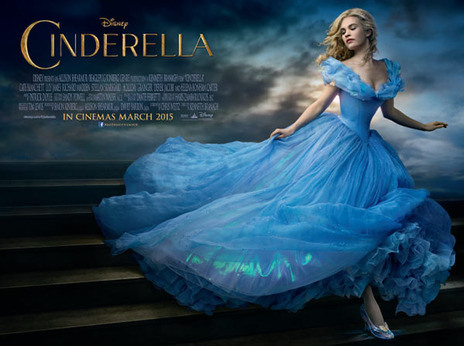
I've Just Seen: Cinderella (2015)

Cinderella (2015)

https://41.media.tumblr.com/c9b1293a43c059a6e22c3b6afaaff7fd/tumblr_o3f1s74TPp1vn5aero1_500.jpg

Director: Kenneth Branagh

Disney's current trend of making "live action re-imaginings" of classic animations sound like a purely financial decision; squeezing new life out of stories already very familiar to children. On the other hand, fairytales (which most of the films are based upon) are the ideal stories to re-tell over and over again, each generation having their own version to enjoy. So rather than approaching this Cinderella with trepidation, I watched with interest.

The original Disney Cinderella film, from 1950, is my least favourite of the Disney princess films, with a Cinderella whose character is less developed than her mouse companions. And while the animation is lovely, particularly the transformation scene, it doesn't have the beauty of the Golden Age in the 90s. Branagh knows how to do visual spectacle, and his Cinderella has plenty of visual flair, from the costumes and sets, to the heighten colour of the image itself. Lily James is a sweet Cinderella, and Cate Blanchett gives depth to the Stepmother, whose nastiness is more complex than previous films.

The influence of other Cinderella films is apparent, from the early meeting of Cinderella and the Prince (Ever After) and Cinderella's final words to her stepmother (The Slipper and the Rose). The film is certainly aimed at young audiences, and did boarder on too sweet in places for my taste. However, I liked it overall, and it is definitely an improvement on the animation.

Monday, 8 February 2016

I've Just Seen: The Green Mile (1999)

The Green Mile (1999)

http://www.warnerbros.com/sites/default/files/styles/key_art_270x400/public/green_mile_keyart.jpg?itok=0rJ5Ju9_

Director: Frank Darabont

My sister loves Tom Hanks (or Otm Shank as she refers to him), and I too am partial to his presence on screen. Comparisons are always made between Hanks and Jimmy Stewart, as they often portray characters defined by their decency and all-American-ness. That decency is on display in The Green Mile, with Hanks playing prison warden Paul Edgecomb, who worked on death row at a prison during the Great Depression.

The film is a strange blend of violence, magic and sentiment, not all of which worked together. Michael Clarke Duncan is very good as mysterious John Coffey, though unfortunately his character is a textbook example of the 'magical Negro', a black character who has powers that, in the story, are used to help the white protagonists. The plot casts Coffey as a Christ-like person, who heals people and absorbs the evil of others.

The violence is rather confronting, and the scene of execution by electric chair, with a crucial step missing, is horrible and feels very realistic. The scene fully plays out the time it takes for the man to die, which is long and agonising. The whole film is really about suffering, both through illness, others' actions, and even mental pain (though this is the least explored).

I am not really sure how I feel about the film. It is surprising, its narrative moving in ways you don't expect, yet it also employs a few problematic tropes. The performances are all good, and the cinematography is good: it is a very handsome production. It is good, but I am not sure I will watch it again.

Thursday, 3 December 2015

I've Just Seen: Delicatessen (1991)

Delicatessen (1991)

https://uk.movieposter.com/posters/archive/main/3/A70-1679

Directors: Marc Caro and Jean-Pierre Jeunet

Caro and Jeunet's film has elements that would be familiar to anyone who has seen Amelie (which is a lot of people). If that was too sweet for you, then Delicatessen, with its boarding house of cannibalistic tenants, might be right up your street. While most of the tenants eat human flesh out of desperation - some kind of disaster has occurred in France, leaving food scarce - the butcher who owns the building seems to get actual pleasure out of killing. The opening scene sets this up beautifully, as one tenant attempts to escape from the building without the butcher seeing him. It is both funny and terrifying.


As is typical of Jeunet's films, every character has a particular quirk or occupation that distinguishes them. One woman in the building is constantly coming up with elaborate suicide scenarios (which always fail); our protagonist Loulson, a circus performer, is constantly practicing his tricks; and Julie, who hates wearing her glasses in front of people, so plans her movements in an attempt to forestall collisions (which doesn't work).


The film is understandably dark in its humour, with Loulson's every encounter with the tenants underpinned by the knowledge that he is 'fresh meat.' There is a brilliantly funny scene when everyone in the house ends up in rhythm together, as the butcher and a tenant have sex (on squeaky bed springs), Julie plays her cello, an old woman knits, Loulson paints the ceiling, and so. All this climaxes together (in more ways than one). It reminded me of the Amelie scene about the number of couples who were all climaxing at that point (answer 15!).

Delicatessen's narrative climax is rather epic, involving bloodthirsty killers, vegetarian rebels, and a lot of water. The whole film is infused with magical whimsy, which creates a good tension with the subject matter. Good fun. 

Wednesday, 18 November 2015

I've Just Seen: The Thief of Bagdad (1924)

The Thief of Bagdad (1924)

http://silenthollywood.com/sitebuilder/images/1924_Thief_Of_Bagdad2-498x747.jpg

Director: Raoul Walsh

Saying that Walsh is the director of this film feels slightly false; while he was the one who decided where the camera would go (wide shots the wise choice throughout), he wasn't the one who decided to write the story, act the lead role, or create the astonishing sets. The latter of the these belongs to art director William Cameron Menzies and his team; the former to silent film star Douglas Fairbanks.

There are several problems with this film, all to do with its age. Though set in Bagdad, the 'good guys' are all played by white actors, while the 'bad guys' are Asian; Hollywood actually did have a racially diverse cast, its just a pity it does so racistly. Anna May Wong, despite playing a deceitful servant to the princess is far more interesting to watch than Julanne Johnson, whose princess is rather forgettable.

That leads me onto another problem with the film, the acting. I personally don't have a great issue with silent film acting, but it doesn't make for psychologically compelling characters. In this story however it doesn't matter as much, for the story has the quality of folk lore and myth. Others, however, may find much to chortle about.

The biggest star of the film is the sets. They are still amazing to modern eyes, and arguably more so as you know that these days it would largely be CGI. Though it is not how Bagdad really ever looked, they are beautiful works of art; the shiny floors add to the lustre of it all. The leaping through the giant pots sequence was a standout. The special effects to, though it is obvious how they were done, are charming and show how inventive early cinema is.

One can't talk about this film without mentioning at length its leading man Douglas Fairbanks. Despite being in his 40s he bounds around the sets with such vigour and his famous winning smile. This was the first of his films that I have seen, and his star quality is obvious. He is the mastermind behind is gorgeous film.

For the problems with the film, I loved it. Unlike the human drama at the centre of The Son of the Sheik (another silent film set in the Middle East), The Thief of Bagdad is pure spectacle, but on such a breathtaking scale that it is hard not to enjoy. I reminded me of my favourite film from childhood, Aladdin, which clearly knew its cinema history.

Thursday, 8 October 2015

I've Just Seen: The Cabinet of Dr Caligari (1920)

Das Cabinet des Dr. Caligari (The Cabinet of Dr. Caligari) (1920)


 http://pics.filmaffinity.com/The_Cabinet_of_Dr_Caligari-311549286-large.jpg

Director: Robert Wiene

While I would never pretend to be a horror film fan, or possess a great knowledge of its history, I feel I have seen enough horror films to appreciate the genre's antecedents in Dr Caligari. Body horror is the sub-genre I have most enjoyed (perhaps because of its interesting relationship with gender), but I also find psychological horror enjoyably unsettling.

Unfortunately, the twist at the film's end was spoiled for me (from studying film history no less); a circumstance which I believe affected my experience. I won't be cruel and do the same to you. Despite that, I am glad it was included in the film; the original writers were apparently annoyed about the framing story's inclusion.

The production design is still quite impressive, setting the story in an abstract space. As a result, the highly stylised acting is more bearable as they are not aiming at realism. The copy I saw carried the Expressionism into the intertitles, which was at first made it difficult to read, but ultimately worked well.

This is not the ideal silent film to see as your first experience of the form. It also helps to know why it is considered so important in film history; just don't let your reading spoil it for you!

I've Just Seen: Wings of Desire (1987)

Der Himmel uber Berlin (Wings of Desire) (1987)

http://www.axiomfilms-shop.co.uk/media/catalog/product/cache/1/image/f63dc5ec28f3175f8a7f615bd217eb71/w/i/wings-of-desire-dvd.jpg
Director: Wim Wenders

Is it not wonderful when, as you are watching a film, you feel yourself falling in love with it? You are charmed, engrossed, eager to know where it is going, yet enjoying each moment for what it is. That is how I felt watching Wings of Desire, and it feels like a highly appropriate response, considering the amount of love and care there is in the story.

I was reminded of A Matter of Life and Death, Powell and Pressburger's similarly gentle romance, where love between humans is presented as the greatest good in the world. I was not surprised to see others had also the connection. I love black-and-white cinematography, and it was used brilliantly here, making the colour sequences feel even more vibrant. The cast were all great; Peter Falk's performance is lovely, exuding a warmth that recalls his Grandpa in The Princess Bride.

There is so much one could say about this film, particularly about its reflective approach to Berlin's past, and the way certain quiet mysteries are revealed. I cannot recommend this highly enough; it is wonderful both formally and narratively, and made me think of other favourite films of mine in a very positive way. Beautiful.

Monday, 28 September 2015

I've Just Seen: Wild Strawberries (1957)

Smultronstället (Wild Strawberries) (1957)

https://s3.amazonaws.com/criterion-production/release_boxshots/4099-25f518e4f42b3977329b44fab0461b56/139_box_348x490_original.jpg
Director: Ingmar Bergman

I feel like I have completed an unofficial trilogy of films that view life from its end: Tokyo Story, Ikiru and now Wild Strawberries. Each film has moved me in different ways; Bergman's film is the most existential of the three, examining Professpr Isak Borg's life from inside his own head.

The title in Swedish is an idiomatic expression that refers to a place that is a quietly significant for a person. For Isak, it is both a literal place where strawberries grow, and a place in this life he associates with his lost love. The film spend much time in the past, as Isak relives many happy and unhappy memories from childhood. The past interacts in the future, as Isak's thoughts are sparked by a physical resemblance between a young hitchiker and his love, both called Sara.

I seem to always approach Bergman's films expecting them to be sombre and difficult to sit through. I don't know why, particularly after seeing The Seventh Seal. While less light-hearted than that film, this was very moving and 'easy' to watch. Hopefully I will stop having this feeling with Bergman, whose status as one of the greatest directors ever is certainly finding no argument with me. A lovely reflection on a life lived (though whether well is up to you to judge). 

Wednesday, 16 September 2015

I've Just Seen: Videodrome (1983)

Videodrome (1983)

https://themovierat.files.wordpress.com/2012/02/videodrome_one_sheet_movie_poster_l.jpg
Director: David Cronenberg

I enjoy body horror as a horror sub-genre, and I really enjoyed Cronenberg's The Fly, so I was looking forward to Videodrome. I am not sure how I feel about it. I think it is a film I shall revisit; the plot was a touch confusing, and hopefully a second viewing will clarify some points for me.

As with The Fly the prosthetic work is really good. I am definitely someone who prefers in-camera effects to simply using CGI for everything (not that it doesn't have its place). The tactility of the prosthetics adds to the grungy, fleshy ideas presented in the story; the pulsating television is an arresting image.

This film is very much of its time, and I can imagine some young people in the next few years watching this and not really understanding the culture of video. For me, video was the way I watched films for the first eleven years of my life, and I felt strangely nostalgic for the grainy image on the screen. An interesting film certainly, and one I will re-watch at some point.

Tuesday, 11 August 2015

I've Just Seen: Monty Python and the Holy Grail (1975)

Monty Python and the Holy Grail (1975)

http://lsc.mit.edu/schedule/2014.2q/poster-montypythonandtheholygrail.jpg
Directors: Terry Gilliam, Terry Jones

This is a film that must be watched with friends; or, at least, make sure they have seen it, so you can quote it to each other all day long. The quotes have become almost a secret language, baffling the ignorant when dropped into everyday conversation: why would you get better from being a newt?

There is a great temptation to simply put quotes in this review. In fact, it would be easier to just attach the screenplay. But even that would not demonstrate how funny this film is; the visual gags of the Trojan Bunny, or the onslaught of flying farm creatures need to be seen to be laughed at. (Bet you are already smiling at the phrase 'Trojan Bunny')

I first saw this when I was eleven or twelve, the ideal age to be introduced to the Python universe. Seeing them from this age means that as you grow up you understand more of the jokes, meaning the film gets funnier as you get older. There is not much more to say about this film but that it is one of the funniest, wackiest films you will ever see. Oh alright, let's end with some quoting: 
King Arthur: I am your king. 
Peasant Woman: Well, I didn't vote for you. 
King Arthur: You don't vote for kings. 
Peasant Woman: Well, how'd you become king, then? 
King Arthur: The Lady of the Lake, her arm clad in the purest shimmering samite, held aloft Excalibur from the bosom of the water, signifying by divine providence that I, Arthur, was to carry Excalibur. That is why I am your king.
Dennis the Peasant: Listen. Strange women lying in ponds distributing swords is no basis for a system of government. Supreme executive power derives from a mandate from the masses, not from some farcical aquatic ceremony.

Tuesday, 28 July 2015

I've Just Seen: Bedknobs and Broomsticks (1971)

Bedknobs and Broomsticks (1971)

http://static.tvtropes.org/pmwiki/pub/images/BedknobsAndBroomsticks_1156.jpg
Director: Robert Stevenson

The influence of Mary Poppins is strong with this film. A magical lady meets a bunch of isolated  children (here physically and emotionally so), teams with a slightly down-on-his-luck man and goes on several adventures, some involving animated creatures. This may be derivative, but Angela Lansbury is always fun to watch and listen to sing, that I am able to enjoy this film without thinking about it too much.

Its biggest failing is that the story is it not stream-lined enough: there is too much going on. They go off looking for David Thomlinson's character, then go looking for a medallion, then come back to save England from the Germans. Had it chosen one overarching story, with one anatagonist, it would have been better. The songs are also not as memorable as Mary Poppins, which is always a shame in a musical film. Best suited to young children, and those with nostalgia complexes.

I've Just Seen: Xanadu (1980)

Xanadu (1980)

http://vignette1.wikia.nocookie.net/lostpedia/images/c/cc/Xanadu.jpg/revision/latest?cb=20120307083936

Director: Robert Greenwald

I can see why this film has become a cult classic: it is so very bad, yet there is some charm to it. It is harmless rubbish, whose only fault is that it dragged Gene Kelly into its bonkers world. There is really not much to say about this film, other then say that the special effects are hilarious, the plot non-existent, the acting superficial, the costumes very eighties, and the animated sequence head-scratchingly random.

Should you see this? Well, you don't have to: but I did, so you should too. It will make you appreciate well-crafted narrative films. It is not an insult to filmmaking, just quite bamboozling.

Thursday, 23 July 2015

I've Just Seen: The Planet of the Apes (1968)

The Planet of the Apes (1968)

http://www.everythingaction.com/wp-content/uploads/2011/08/planet-of-the-apes.jpg

Director: Franklin J. Schaffner

This is another watch-it-with-my-sister film that I had already seen. She had seen the ending (one of the worst kept secrets in film history), but wanted to see the beginning. This is a good film to re-watch: the first time I saw it I focused on the more overt, and at times clumsy, analogy of this world with 1960s America. On second viewing I picked smaller parts of the story and the characters.

Heston's Taylor's relationship with Doctor Zaius is rather complicated, and the most interesting part of the film (for me). Dr Zaius knows the truth about the whole situation, more than any other character in the film. While Taylor believes himself to be on another planet that is hospitable, Zaius warns Taylor at the film's end that Taylor may be in for a rude shock. And, call me stupid, but the first time I watched the film, I didn't quite piece together that the 'You blew it up' quote was a reference to the Cold War. Derrr!

Though this is by no means a perfect film, it is a must-see. As I said, this has the worst kept 'surprise' ending; I wish that I had been able to see it without knowing the ending (though it is quite obvious: they speak English for goodness sake!).