Showing posts with label Swedish Cinema. Show all posts

Thursday, 21 September 2017

I've Just Seen: Cries and Whispers (Viskningar och rop) (1972)

 Director: Ingmar Bergman

Cries and Whispers, like Persona, looks at the complexities of female relationships. In this film the relationships are familial, between three sisters and a maid. Unlike Persona, where the two women seemed to be blurring into one another, two of the sisters in Cries and Whispers, Maria and Karin, struggle to overcome their own lives in order to support the dying Agnes. Only Anna, the maid, responds with complete love and devotion to Agnes in her pain.

The film doesn't follow a linear storyline, instead flashing back in time to memories of Agnes' childhood, Maria's infidelity, Karin's horrific episode of self-mutilation (which made me queasy), and Anna's reflection on her dead child. There is also a scene, which could be a dream or a real shared experience for the women, where Agnes comes back to life and begs her sisters to comfort her. This engimatic approach makes this a film one experiences and then pieces together afterwards.

The cinematography is utterly beautiful, with its etheral white costumes contrasted with the plush red furniture and decoration in the house. It keeps us entralled in this emotionally complex situation, as the sisters and Anna grapple with their own fears around death, their bodies, and questions of happiness and faith.

Like almost all of Bergman's films, I want to watch this again to see what a second viewing reveals about the characters. The film's overall tone is one of deep introspection that reveals many painful truths for the women (and the audience), yet the ending is one of quiet hope and joy for sisterly togetherness. As devastating as it is beautiful.

Friday, 26 February 2016

I've Just Seen: The Virgin Spring (Jungfrukällan) (1960)

The Virgin Spring (Jungfrukällan) (1960)

http://9502-presscdn-0-95.pagely.netdna-cdn.com/wp-content/uploads/2015/09/VirginSpringThe052013LC.jpg

Director: Ingmar Bergman

Each Bergman film I watch makes me love the director even more. While The Virgin Spring is not one of his most famous filmss or his best, it is a natural companion to The Seventh Seal, being set in medieval Sweden, and involving a crisis of faith for a character played by Max von Sydow.

There is a moral complexity to this apparently simple story of parental revenge. The titular 'virgin' Karin is a slightly spoiled young woman, who falls foul of some herdsmen; they return her generosity (she shares her meal with them) with rape and murder. We the audience spend the whole time thinking "No, don't interact with them!' while she displays the Christian teachings her parents have taught her, teachings which would usually be applauded. Her parents reaction to her awful death is to kill as well, an understandable act that goes against their beliefs (turn the other cheek, do not kill).

The film was controversial at the time for its rape scene. Though some of the impactis now lessened, such scenes are not uncommon in modern film, the passive bystanding perspective of the camera, and the quietness of the act itself (Karin cannot scream) makes it insidiously shocking. I felt her fear without even seeing her face.

The ending reminded me of the end of Ordet with its apparent sign of God's presence. This gives the film a more positive ending than The Seventh Seal, where God remains silent. As always with Bergman the cinematography is beautiful, the black-and-film working to place us in the medieval period, and underscoring the moral dilemmas at the centre of this story. It is sad, beautiful and quietly powerful.

Friday, 11 December 2015

I've Just Seen: Scenes From a Marriage (1973)

Scener ur ett äktenskap (Scenes From a Marriage) (1973)

http://movieworld.ws/wp-content/uploads/2012/09/Scenes-from-a-Marriage.jpg

Director: Ingmar Bergman

While this was broadcast as a television series, and the story is told in sections, I watched it as a (really long) film. Wikipedia tells me the theatrical version (which I watched) is 167 mins to the 281 mins for television; what was left out I don't know.

Over almost three hours we follow Marianne and Johan (Liv Ullmann and Erland Josephson) as they examine the changes in their relationship; think the Before series of films. While the first few 'episodes' have other characters in them, the rest are just Ullmann and Josephson talking to each other. Their performances are very, very good; the changes in the dynamic of their relationship are beautifully moved through. How much of the dialogue was scripted and how much was improvised I don't know; they speak it so naturally.

The cinematography style is a very still camera, with many shots lasting for minutes with no cuts. There is little 'action' in terms of people striding around amazing sets. Instead we have intense conversations happening in small rooms, made to feel even smaller through the close-ups on Ullmann and Josephson's faces.

Each Bergman film I watch makes me appreciate him as a director. Scenes From a Marriage demonstrates how good he is with actors and characters; his eye for explaining characters through gestures and body language as well as dialogue. I am interested in seeing the five hour version, even though Marianne and Johan are not always fun to be around!

Monday, 28 September 2015

I've Just Seen: Wild Strawberries (1957)

Smultronstället (Wild Strawberries) (1957)

https://s3.amazonaws.com/criterion-production/release_boxshots/4099-25f518e4f42b3977329b44fab0461b56/139_box_348x490_original.jpg
Director: Ingmar Bergman

I feel like I have completed an unofficial trilogy of films that view life from its end: Tokyo Story, Ikiru and now Wild Strawberries. Each film has moved me in different ways; Bergman's film is the most existential of the three, examining Professpr Isak Borg's life from inside his own head.

The title in Swedish is an idiomatic expression that refers to a place that is a quietly significant for a person. For Isak, it is both a literal place where strawberries grow, and a place in this life he associates with his lost love. The film spend much time in the past, as Isak relives many happy and unhappy memories from childhood. The past interacts in the future, as Isak's thoughts are sparked by a physical resemblance between a young hitchiker and his love, both called Sara.

I seem to always approach Bergman's films expecting them to be sombre and difficult to sit through. I don't know why, particularly after seeing The Seventh Seal. While less light-hearted than that film, this was very moving and 'easy' to watch. Hopefully I will stop having this feeling with Bergman, whose status as one of the greatest directors ever is certainly finding no argument with me. A lovely reflection on a life lived (though whether well is up to you to judge). 

Tuesday, 21 July 2015

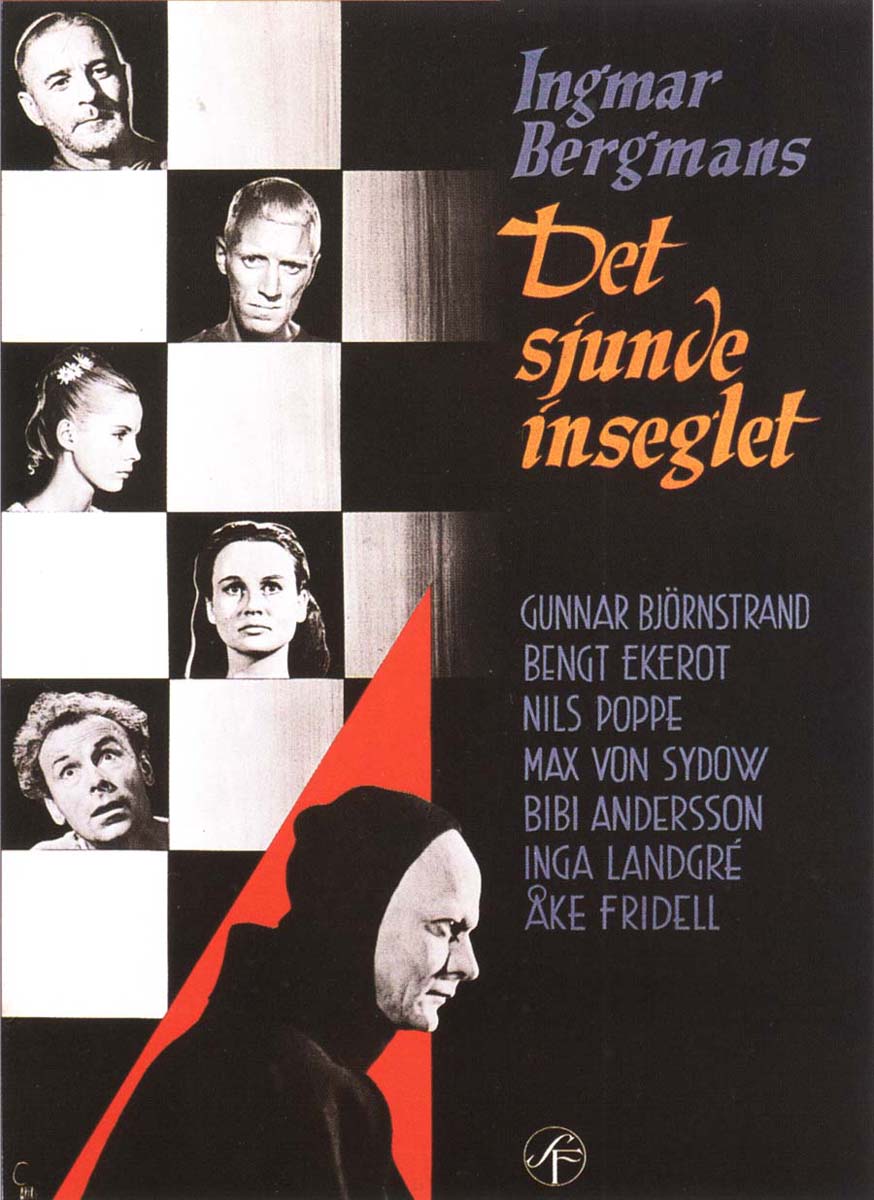
I've Just Seen: The Seventh Seal (1957)

The Seventh Seal (Det sjunde inseglet) (1957)

https://rezensiolo.files.wordpress.com/2011/07/1957_seventhseal_06.jpg
Director: Ingmar Bergman
Writer: Ingmar Bergman, from his play Tramalning

The Middle Ages has always fascinated me: I studied its history and literature at university, and even did a year of Latin, thinking I might become a historian. That clearly did not happen. However, my interest still exists, and I always look out for films that depict the era. Unfortunately (for me, at least), most films about the era are unsatisfying; one day I shall go into why I think that. But having seen other Bergman films, and knowing The Seventh Seal's reputation, I felt that I could expect an interesting portrayal of the era. I was not disappointed.

This film is famous for the scene of Death and the knight playing chess; the scene looks grim and depressing. The existential crisis at the film's centre also creates expectations of dark reflections from Bergman. So imagine my surprise when there were moments of humour and levity, even joy in the film. The whole story blended theology, humour, death and sex, and used metaphor, in a way reminiscent of Chaucer, one of my favourite writers.

Gunnar Fischer's black-and-white cinematography is wonderful, complementing Bengt Ekerot's Death. Max Von Sydow is good as the knight desperately wanting to know if God really exists. For me this ranks up high with Tarkovsky's Andrei Rublev, another thoughtful depiction of the Medieval period. This is going on my Favourite Films list.