Showing posts with label Western. Show all posts

Wednesday, 2 January 2019

True Grit (1969)

 Director: Henry Hathaway

If you are going to make a Western called "True Grit" it seems impossible you would cast anyone other than John Wayne in the lead role. Perseverance, or stubbornness, is a trait shared by many of the characters he played: Ethan Edwards in The Searchers immediately springs to mind. Here he plays "Rooster" Cogburn, hired by Mattie Ross to avenge the murder of her father by one of his workers. As with many of Wayne's roles, his steeliness of resolve is contrasted with the tender feelings he develops towards Mattie, becoming a father-figure for the fatherless teenager.

The film as a whole is entertaining and really well acted. Wayne is clearly enjoying the material, and he reportedly loved the script for the film. It is certainly a meaty role for him. Kim Darby is energetic in her portrayal of Mattie; one could argue she has the most "grit" of any of the characters. The scene where she haggles of the buying and selling of horses is good fun. The cinematography is lovely, along with the Colorado geography, despite it being set in Arkansas and Oklahoma (though being Australian I didn't notice the difference).

The only glaring flaw in the film is its pacing. It takes a long time for Cogburn, Mattie and La Boeuf to set out on their journey, with much discussion about who will and will not go. This doesn't really build tension, as you know who the three people going will be, and it just delays the inevitable. I imagine the remake is more economical in its first act.

While there is nothing ground-breaking in True Grit, it is a solid, well-made Western that has a rather sweet ending. It is hard not to enjoy a film where all the elements - writing, acting, directing, cinematography - are so good. It will be interesting to compare to the Coen Brothers' version.

Tuesday, 27 November 2018

Bring Me the Head of Alfredo Garcia (1974)

Director: Sam Peckinpah

The title of Peckinpah's film is eye-catching, making you wonder who is Alfredo Garcia, what did he do to risk losing his head, and who will go and get it. Being a Peckinpah film you can expect the answer will come with a lot of violence, including multiple shoot-outs. The story focuses on the getter of head, Bennie, and the cost this expedition has for him.

I haven't warmed to Peckinpah's style. I do admire the way he shoots violence, which is impressionistic, with its slow-mos overlaid with loud gunfire, disorientating you as though you were part of the action. He does also focus on interesting characters. My problem is the story is often not as compelling as it could be, and as someone who tires of too much violence quickly (unless it is in horror), I get tired watching his films. All this is true of Alfredo Garcia.

I can't say much more about the film because it didn't grab me. I watched it a few weeks ago, and haven't thought about it since. Peckinpah clearly has his fans, several of his films appear on the 1001+ Films lists, but he doesn't do much for me.

Friday, 27 October 2017

I've Just Seen: Westworld (1973)

Director: Michael Crichton

Science-fiction and Westerns genre mash-ups often make curious films. Science-fiction is usually focused on the future and technologies interacting with humans; Westerns almost invariably look to the past, and humans in a more primitive mode of survival. Westworld marries the two genres together in a really clever way, exploring these ideas around technology and survival.

The Westworld of the title refers to one of three themed worlds featured at the theme park Delos; the other two are Medievalworld and Romanworld. Each world gives he guests are immersive experience in either the American Old West, Europe in the Middle Ages or Roman Empire life (the last two are the experiences of the elite, naturally). Two guests to Westworld, Peter and his friend John (who is on a repeat visit) enjoy the life of a cowboy in the Old West, even having a duel with a cold-blooded gunslinger, played by a brilliant Yul Brynner. However, malfunctions starts happening, making the androids' "do not kill" function stop working. Guests start getting killed, and Martin finds himself being pursued by Brynner's vengeful Gunslinger.

So much about this movie works really well. The concept for a start is extremely good, and very fertile ground for storytelling: no wonder it has been turned into a TV series several times. The character of the Gunslinger clearly inspired the Terminator, with its relentless pursuit of its intended victim. The film was also rather predictive with its analogy of the systems malfunction to a virus. To modern minds this sounds obvious, but many in the 70s would have found it new, and no doubt frightening.

This is a very clever and thought-provoking film, one I am surprised Hollywood hasn't remade as a film (the TV series likely stopped that from happening). Its ideas are ones we are still grappling with, and it is potentially for horrifying for us as robots become more and more common in everyday life.

Thursday, 11 August 2016

I've Just Seen: Once Upon a Time in the West (C'era una volta il West) (1968)

Once Upon a Time in the West (C'era una volta il West) (1968)


Director: Sergio Leone

In general I am not a fan of Westerns, though I have enjoyed the odd one or two (The Searchers, The Good, the Bad, and the Ugly). Unfortunately for me, they seem to populate film lists, especially the 1001 Movies list. Despite the regard Leone's film is held in, I approached it reluctantly, and found myself very surprised: I loved it! I didn't think Leone could better The Good, but Once Upon a Time in the West is a brilliant film in every respect. In fact the only thing that ruined it for me was the sound going out of sync on the Blu-ray copy I watched, and that had nothing to do with the film itself.

It is hard to pin down what it is that makes this film so wonderful, which means that it is a combination of all the elements of filmmaking that elevate this piece. The score is exceptional. It is not just one piece of music that stands out, but all of it, from the piercing harmonica theme that accompanies Charles Bronson's unnamed man, to the haunting, melancholic tone of the track that relates to Jill McBean. The cinematography is incredibly memorable, with its widescreen shots that cut to extreme close-ups on our character's eyes. The performances are all note-perfect, and the casting of Henry Fonda as the villain is a stroke of genius. It completely unsettles you as you discover that the lovely character from The Grapes of Wrath, The Lady Eve and 12 Angry Men has callously killed a whole family.

The story takes the well-known tropes of Westerns - the coming of the railway (and consequently civilisation), and the man with the unknown past (and name) - and turns it into myth; hence the film's evocative title. The film deserves its place on all those essential films lists, and has gone some way to curing my apathy to the genre. Watch this one the biggest screen you can to fully appreciate those dramatic edits of landscapes to faces, with the best sound system, so that the score is etched on your mind.

Wednesday, 1 June 2016

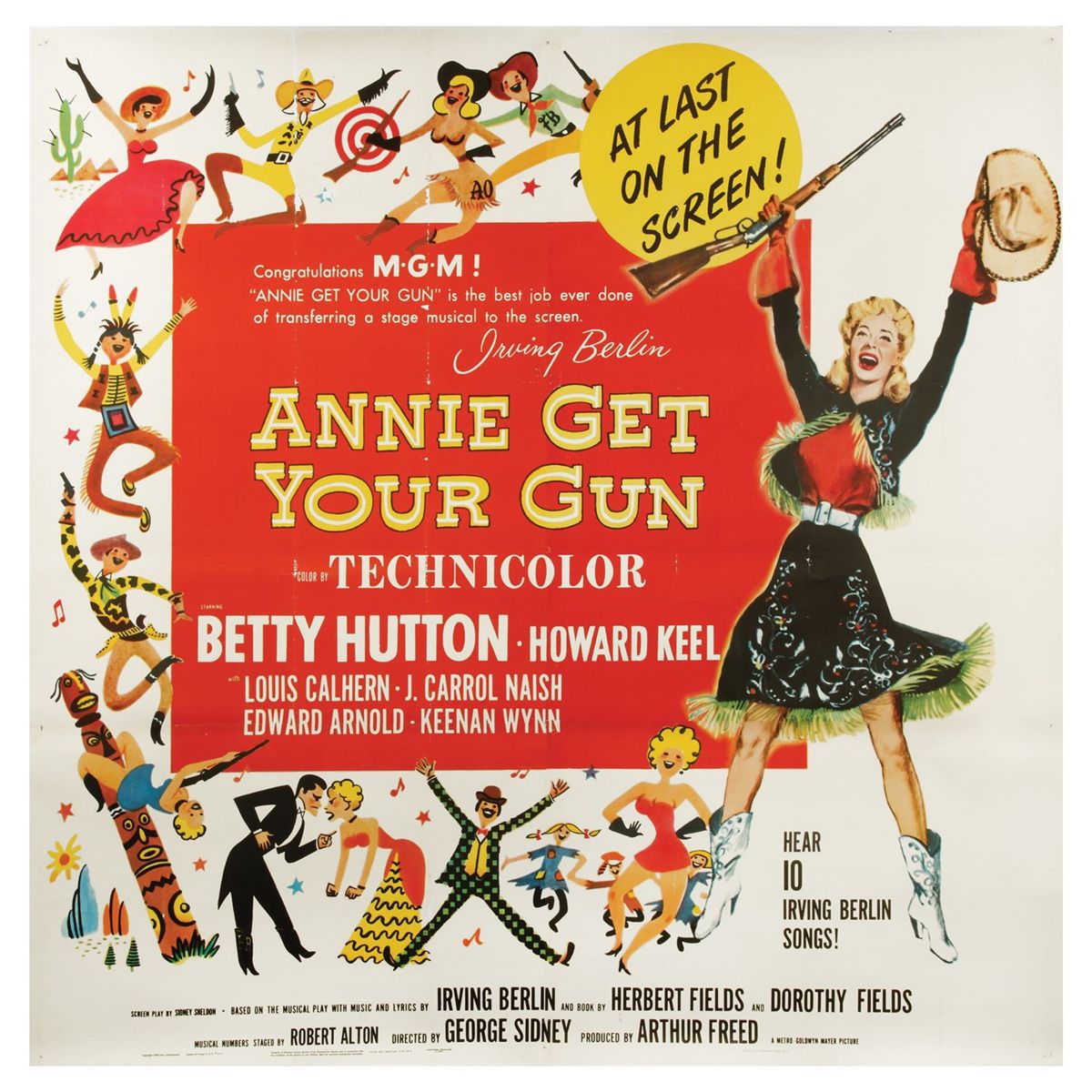
I've Just Seen: Annie Get Your Gun (1950)

Annie Get Your Gun (1950)

https://farm4.staticflickr.com/3899/14371667926_aca83212c3_o.jpg

Director: George Sidney

I watched Annie Get Your Gun on a rainy Sunday afternoon, the perfect climate for seeing a 1950s Technicolor musical. While not as polished as Calamity Jane, the Doris Day vehicle released by Warner Bros. in response to Annie's popularity, Sidney's film is a huge amount of fun. I recognised many of the songs, not realising this is where they orginated; 'There's No Business Like Show Business' and 'Anything You Can Do' are just two of them.

Betty Hutton's is not subtle by any means, but she plays Annie Oakley with such gusto and enthusiasm that I was charmed by her. Knowing that filming was difficult for her makes her performance even more impressive; many of the cast and crew were cold towards Hutton because she replaced an unreliable Judy Garland. As brilliant as Garland is on screen, I can't imagine her playing Annie with the same energy.

Some parts of the film have aged badly; the racial politics are cringeworthy, particularly the 'I'm an Indian, Too' sequence. If you hate musicals this is not going to change your opinion of them. I enjoyed myself, and would happily see it again, particularly the next time a lazy Sunday afternoon comes by.

Monday, 11 April 2016

I've Just Seen: Tampopo (1985)

Tampopo (1985)

http://jon.porkbuns.net/photos/blog/movies/tampopo/tampopo-poster.jpg

Director: Juzo Itami

It is often thought that comedies do not cross language and cultural barriers as well as drama does. While death and grief are sad in any language, what makes one laugh is not. Thankfully this is not true for Tampopo, a Japanese film that follows a man's mission to help a widow run a successful ramen shop. Food is central to the story, and one of the first sequences is of a man teaching a younger man the correct way to eat ramen; what order to eat the noodles, pork, egg and slurp the soup. It is very funny, and unless you have just eaten, will leave you hungry.

The significance of food, and the references to American Western films is what makes this film work so well. Alongside the main narrative are little vignettes that show how food operates in other people's lives. They are by turns funny (a young couple who use food during sex); poignant (a man who chases a woman manhandling good in a grocery shop); to the tragic (a mother cooking for her family one last time). I could easily slip into the cliched use of food metaphors to describe why this film is so good, as it understands that sweetness and savouriness are both necessary for a good meal, and that getting that balance right is vital. A lot of the humour also comes from the Western elements, with Goro (Tsutomu Yamazaki) wearing the cowboy outfit for most of the film, and a hilarious stand-off he has with Pisken, a rude customer.

There is so much to enjoy about this film, and the only problem with it is that it will leave you craving ramen, a craving hard to satisfy at night where I live.

Tuesday, 1 March 2016

I've Just Seen: A Girl Walks Home Alone at Night (Dokhtari dar šab tanhâ be xâne miravad) (2014)

A Girl Walks Home Alone at Night (Dokhtari dar šab tanhâ be xâne miravad) (2014)

http://static3.aintitcool.com/assets2012/aicncomics/agwhaan1.jpg

Director: Ana Lily Amirpour

Few films mix genres so readily as Amirpour's film. Part Western, part vampire horror, part romance, part gangster, set in a Iranian 'Bad Town,' all filmed in black-and-white. A Girl Walks Home moves through its story, giving its audience little sense of what is to come next; whether the next person The Girl looks at will be attacked, helped or seduced.

While I did not fall in love with the film the way many others have, it is was difficult not to be impressed by it. The film wears its feminism on is sleeve (or chador), but it fits naturally into the plot, and cleverly re-works the traditional male vampire/ female victim relationship we usually get. The cinematography is moody, most scenes taking place at night, lit by feeble street lights. The figure of The Girl walking around in the long, black chador already feels iconic, and she appears to float over the footpaths (at one point doing so on a skateboard).

I shall definitely revisit A Girl Walks Home, as it is a film that requires you to invest in it, with many scenes playing out without any dialogue at all. Gestures and expressions are the main forms of communication throughout the story, and can be missed if the film is watched casually. Dark and unique.

Sunday, 28 February 2016

I've Just Seen: Paris, Texas (1984)

Paris, Texas (1984)

https://s-media-cache-ak0.pinimg.com/236x/c9/01/11/c901115b557341dcd82397f42219fd7f.jpg

Director: Wim Wenders

Wenders injects his films with a huge amount of compassion. He appears to pass no judgement on his characters, looking at them as creatures who behave in ways that lead to unhappiness in themselves and their loved ones, yet ultimately have inherent goodness. We don't know exactly what Travis Henderson has done, where he has been or where he is going, but Wenders draws us in to care about his situation.

I did not know what I was going to get with Paris, Texas and know I shall revisit it in the future. It has been compared to The Searchers, particularly the ending, and the opening setting, where a man seems to appear out of the landscape of Texas. The cinematography is beautiful throughout, from the wide shots of the desert that almost swallows Travis' figure, to the intimate faux domestic settings of Travis and Jane's meetings. The performances are all lovely, especially Hunter (Carson), Travis' son. The development of their relationship is wonderfully understated, the moment of connection captured in a exchange of smiles.

Though it did not capture me in the way Wings of Desire did (though few films have) I am really loving the way Wenders approaches film. The care and love of the characters for each other is matched by the care and love Wenders brings to the project. Would be wonderful to see on the big screen.

Friday, 25 December 2015

I've Just Seen: The Searchers (1956)

The Searchers (1956)

http://www.moviesontheroof.com/2010/images/searchers.jpg

Director: John Ford

Westerns are not a genre I gravitate towards, and I must confess, this is only my second Ford film (The Grapes of Wrath is the other). His films are clearly not all held in such high esteem as The Searchers, but on the evidence of this one, I shall have to rectify my ignorance very quickly. The Searchers' standing as one of the greatest films of all time is well deserved. There are so many elements that make this wonderful, and they have been raved about by better critics and writers than me, that it is hard to write about the film at all.

Cinematography often gets mentioned as a side element to a film, with story and acting getting the main pludits (or bashing). Here, the cinematography grabbed me from the opening shot, one of the most famous in film history; the black screen that is suddenly split by the light emanating from an open door that leads onto the harshly beautiful Monument Valley. The camera tracks behind the silhouette of a woman who watches the approach of a man on horseback. In the first shot, Ford introduces the centrality of women to this Western film, arguably the most masculine of all the genres.

The purity of cinema continues with the suggestion of affection between Wayne's Ethan and his sister-in-law Martha. Their exchanges are filled with restrained longing on his side, and wistful love on hers. Ethan's feelings help fuel his pursuit of his lost niece, who Ethan treats as his favourite.

I was surprsied by the number of suggestions of sexual violence in the film; we never see anything, but as is often the case, this makes it even more shocking. The audience is left to imagine the horror Ethan sees inside the chicken coop and the desert valley, or what Debbie has experienced as a captive.

Wayne's Ethan Edwards is a difficult character to like, but that is part of the genius of the film. We understand his anguish at what has happened to his family, but also find his violent, racist attitude hard to accept. The revelation of his true motives in his pursuit of Debbie is shocking. 


A wonderful film that has one of the best bookending shots in cinema. Definitely one to watch again, and learn from Ford about how to capture light, colour and unspeakable feelings on camera.

Saturday, 3 October 2015

I've Just Seen: McCabe and Mrs Miller (1971)

McCabe and Mrs Miller (1971)

http://www.astortheatre.net.au/wp-content/uploads/mccabe-poster.jpg
Director: Robert Altman

This is the third Beatty and Christie pairing I have seen in film; the other two are Heaven Can Wait and Shampoo. This is arguably the least romantic and bleakest film of the three. Altman, one of the heavyweights of the American New Wave, here portrays a rather complex image of the macho American gunslinger who enters town a mysterious man. McCabe's image is challenged by Mrs Miller, a woman with actual business smarts; McCabe merely believes he has them, but is easily swayed by Miller.

The cinematography is deliberately aged to mimic photography from the early twentieth century. Things look slightly out of focus and unclear, much like the world the characters inhabit. It was stiking to see the new buildings in the film; most of the time, period films have houses and shops that look old (as they do to us), rather than how they looked to the people at the time.

McCabe and Mrs Miller is a film I would say I appreciated rather than enjoyed. Altman certainly has his own style, and clearly knew how to direct actors. I prefered MASH because of its humour, but both films have a similar melancholy underneath their stories.

Wednesday, 30 September 2015

I've Just Seen: Duel in the Sun (1946)

Duel in the Sun (1946)

http://images.moviepostershop.com/duel-in-the-sun-movie-poster-1946-1020206338.jpg
Director: King Vidor

My problems with melodrama were rather irritated by this film. It is technically classified as a Western, but the scenery often vies with the overwrought emotions of the actors. The film is comparable to Gone With the Wind; a rather sweeping story, with a young woman torn between two very different men at the centre. The two films also had David O. Selznick as producer, and looked gorgeous in Technicolor. But where Gone With the Wind succeeded, with its acting, Duel in the Sun faltered.

The attractiveness of the images (and people) on screen were the most enjoyable parts of this film. The costumes are lovely, though at times barely managing to cover Jennifer Jones in some scenes. Gregory Peck is the meanest I have seen him, but I could see why Jones' Pearl was attracted to him. Of the actors, Lillian Gish was the best, showing a subtle to her acting that she had in her silent films.

Ultimately I didn't really like this; characters swung from one extreme emotion to another, without any real explanation about how they got there. While Pearl's predicament is hard and she is judged by all for the way she looks, the film handled that plot without any depth. A disappointment, despite the cast.

Wednesday, 1 July 2015

I've Just Seen: The Good, the Bad and the Ugly (1966)

The Good, the Bad and the Ugly (Il Buono, il Brutto, il cattivo) (1966)

http://i.jeded.com/i/the-good-the-bad-and-the-ugly-il-buono-il-brutto-il-cattivo.9123.jpg


Director: Sergio Leone

I had seen this film many years ago (about twelve I would say). All I could remember were Leone's signature close-ups, and the wonderful score from Ennio Morricone (wah, wah, waaaaah). My sudden desire to revisit this classic was sparked by my film course, as the short film we made nodded to the Western genre, and we all had this song in our head for the last week.

I am so glad I revisited this: it truly is wonderful. Watching it now with a critical eye, I can see just how good Leone's direction is, and how beautiful Tonino Delli Colli's cinematography is. The plot is simple, only working to provide a spot on the horizon that all our characters are heading towads. The changes in the dynamic of the central trio is where the fun is to be had. The three share several similarities: they are all determined, self-serving and resourceful. Eastwood, Van Cleef and Wallach give them distinctive characteristics, particularly Wallach, who is a great big ball of ugly energy. We don't really have a main character, though Blondie and Tuco feature more throughout the film.

The Western is a genre I have only sampled. I really enjoy the streak of wry humour that runs throughout this film; the more earnest Westerns from the 50s, though still very good, don't engage me as much. But hey, I've only dipped my toe into the genre, I may change my mind yet.