Sunday, 13 March 2016

I've Just Seen: Napoleon (1927)

Napoleon (1927)

http://www.michaeldvd.com.au/CoverArtUnverified/7550.jpg

Director: Abel Gance

Filmmakers, unfortunately, don't make biopics like this anymore. Rather than attempt to recreate every event in Napoleon Bonaparte's life, aim at historical verisimilitude, or try to probe into the psychology of this famous character, Gance opts for operatic mythologising. From the opening moments of this epic sweep, we see stirrings of greatness in young Bonaparte, a greatness not recognised by his (snobby) peers. As someone who grew up on English history and comedy, where Bonaparte was the butt of jokes, and the great enemy of Britain, this heroic depiction of the French emperor made my experience all the more fresh and interesting.

I saw the three hours, forty-five-ish cut of the film, with a fantastic score by Carmine Coppola. Incorporating themes from other famous composers, with "La Marseillaise" a constant throughout, the music helps strengthen the epicness of the story. It is particularly masterful in the scene where de Lisle teaches the masses to sing the anthem, their silent voices in time with this famous tune. With its use of French Impressionism techniques, Gance's film feels alive and fresh, the camera moving around with great energy; the scene of Bonaparte being swept around by a storm at sea intercut with scenes of discontent at the National Assembly represented by a swinging camera was a personal favourite.

I really liked this. While long, it rarely dragged, and though I know the ultimate outcome of this period of history, I was swept along by the bravado of the storytelling. It has been added to my list of films I want to see on the big screen, ideally with a live performance of Coppola's score.


Friday, 11 March 2016

I've Just Seen: Carol (2015)

Carol (2015)

http://www.liveforfilms.com/wp-content/uploads/2015/11/carol-1.jpg

Director: Todd Haynes

I am relishing the recent renaissance of film stock use in modern cinema. While digital certainly has its positives (easier, cheaper), there is something truly beautiful about the texture of film. Its use of chemicals and light to compose an image are like art, like the Roman frescoes, both long lasting and yet fragile.

The beauty of the image is what most struck me about Haynes' Carol, filmed on 16mm stock by Edward Lachman. The colours of the clothes, the furnishings, the make-up and even the skin tones of the characters are wonderfully rendered, highlighting the world we are in: 1950s America. There is also a chilliness to the texture, aiding the wintry setting of the story.

As many have noted, the performances of Rooney Mara and Cate Blanchett are very good, their facial expressions and gestures doing most of the talking. Mara intense eyes are put to good use, as she spends much of the film observing Carol, her friends and also herself, as she tries to work exactly what she is feeling. Blanchett's Carol has more at stake, and though her character is more experienced than Therese, there is a underlying level of vulnerability throughout her performance.

While I was not as blown away by Carol as much as many critics were, it is a wonderful piece of cinema about a seemingly familiar story that doesn't hit the cliches you would expect. And few films are as aesthetically beautiful as this.

Wednesday, 9 March 2016

I've Just Seen: Suddenly Last Summer (1959)

Suddenly Last Summer (1959)

http://classicfilmsreloaded.com/images/Poster-Suddenly-Last%20Summer.jpg

Director: Joseph L. Mankiewicz

Many films promise a shocking secret at the heart of their stories, a horrible event in the past that continues to haunt the remaining characters. Unfortunately, often the secret is not shocking, either because you have guessed it by the end of Act One, or it proves to be rather more limp than you had hoped. The secret at the heart of Suddenly, Last Summer is still a shock over fifty years later, and part of that is the centrality of topics we think of as taboo in 1950s cinema. If it sounds like I am tip-toeing around the subject, it is because this film deserved to be seen as clean as possible so the horror of the situation is able to sink in.

The performances of the cast as all great, particularly a wonderfully brittle turn by Katherine Hepburn as Violet Venable, a woman so deep in denial about the truth surrounding her son. Montgomery Clift is post-car crash here, but his subdued portrayal of Dr. John Cukrowicz works well as he gathers evidence about the truth, and exhibits genuine sympathy for Elizabeth Taylor's Catherine Holly. Taylor is the third part of this tense triangle, and arguably has the hardest job of portraying a young woman haunted by awful memories. While she occasionally threatens to fall into histronics, she is great in the third act, finally revealing the terrible secret.

The film doesn't seek to shake off its theatrical origins, with its many long scenes; the meeting between Violet and John in the garden goes for over twenty minutes. These allow the characters to breathe, telling us about themselves and each other, and increasing our curiosity over the unspoken secrets. Prepare to be frustrated and slightly creeped out.

Monday, 7 March 2016

I've Just Seen: The Madness of King George (1994)

The Madness of King George (1994)

http://images.moviepostershop.com/the-madness-of-king-george-movie-poster-1994-1020210074.jpg

Director: Nicholas Hytner

When watching British films, I like to play the game 'How many people do I recognise from the cast, and what else have I seen them in?' I sit there thinking "Oh, there's 'so and so' from 'that thing,' or 'Ha, those two were husband and wife in something else, here they are mistress and servant!' Hytner's film, with its expansive cast of British thesps provided ample opportunity for such games.

The film is lavish yet intimate, with its focus on the medical emergency of King George III, who eventually went mad and was replaced by his son as Prince Regent. Like all films about royalty, the personal and the political are inextricable, with choices about marriage, health, and friendship affecting the country (apparently).

The performances are all good, with Nigel Hawthorne managing a difficult role well: he at times has to move between madness and cognisance in one scene. The supporting cast are good at reacting with bafflement and concern, and Rupert Everett is having fun as the opportunistic Prince George (with a shockingly awful head of hair).

The script is naturally strong, coming from the pen of Alan Bennett, but I spent much of the film wondering how it would work on stage, and think that it would be more impressive acted in a small space where that confinement would intensify the story. This is a solid historical drama that, similarly to The King's Speech and The Queen, dramatises a real life crisis for the English monarchy. Enjoyable, if lacking great depth and insight.

Thursday, 3 March 2016

I've Just Seen: Nightcrawler (2014)

Nightcrawler (2014)

http://www.indesignskills.com/wp-content/uploads/2015/03/night-crawler-2.jpg

Director: Dan Gilroy

Most villians in horror films, usually the personification of particular human fears, rarely scare me. I am aware they are a construct often carried to its extreme, and I generally admire their depiction rather than cowering at their presence. Though Gilroy's film is not in the horror genre, the character of Louis Bloom is a truly frightening creature, largely because he seems so very human. We know there are people like Louis Bloom in the world; people so determined in their pursuit of their dreams that they really will stop at nothing to achieve them. And even more concerning, society generally rewards such behaviour.

We are in a similar world to Philip Marlowe's 1940s L.A. in Nightcrawler: a dark, crime-ridden city populated by amoral types. These 'nightcrawlers' scuttle around the city like insects, looking for delicious stories (bloody car crashes, police shoot outs, drug busts - the more horrific the better) to satisfy the rolling News channels. Gyllenhaal's Bloom finds he has a good eye for capturing this footage, sometimes an even better eye than the real event itself - he moves bodies in order to emphasis their mangled state, and cuts out shots that don't work with the narrative he wants to tell.

Gyllenhaal performance is perfect. His natural charm and good looks are contrasted with an awful haircut and terrible clothes, which give him a creepy vibe. Gyllenhaal uses his strking eyes to full effect, as Bloom maintains an intense gaze throughout, a gaze that seems to be focused on his next goal, whether that be appraising a crime scene, or pressuring another character to do what he wants. Rene Russo and Riz Ahmed are wonderful as Bloom's closest colleagues, Nina and Rick. They bear the brunt of Louis' psychopathic behaviour, but have very different reactions to it.

This is a great film, and is particularly impressive in its depiction of a truly amoral character. Gilroy breaks one of the cardinale rules of screenwriting: the main character going on a journey, and some part of them changing as a result (usually for the better). Louis Bloom doesn't really change: he character simply gets stronger, confirmed in its own habits and beliefs. And that leaves the audience deeply unsettled.

Wednesday, 2 March 2016

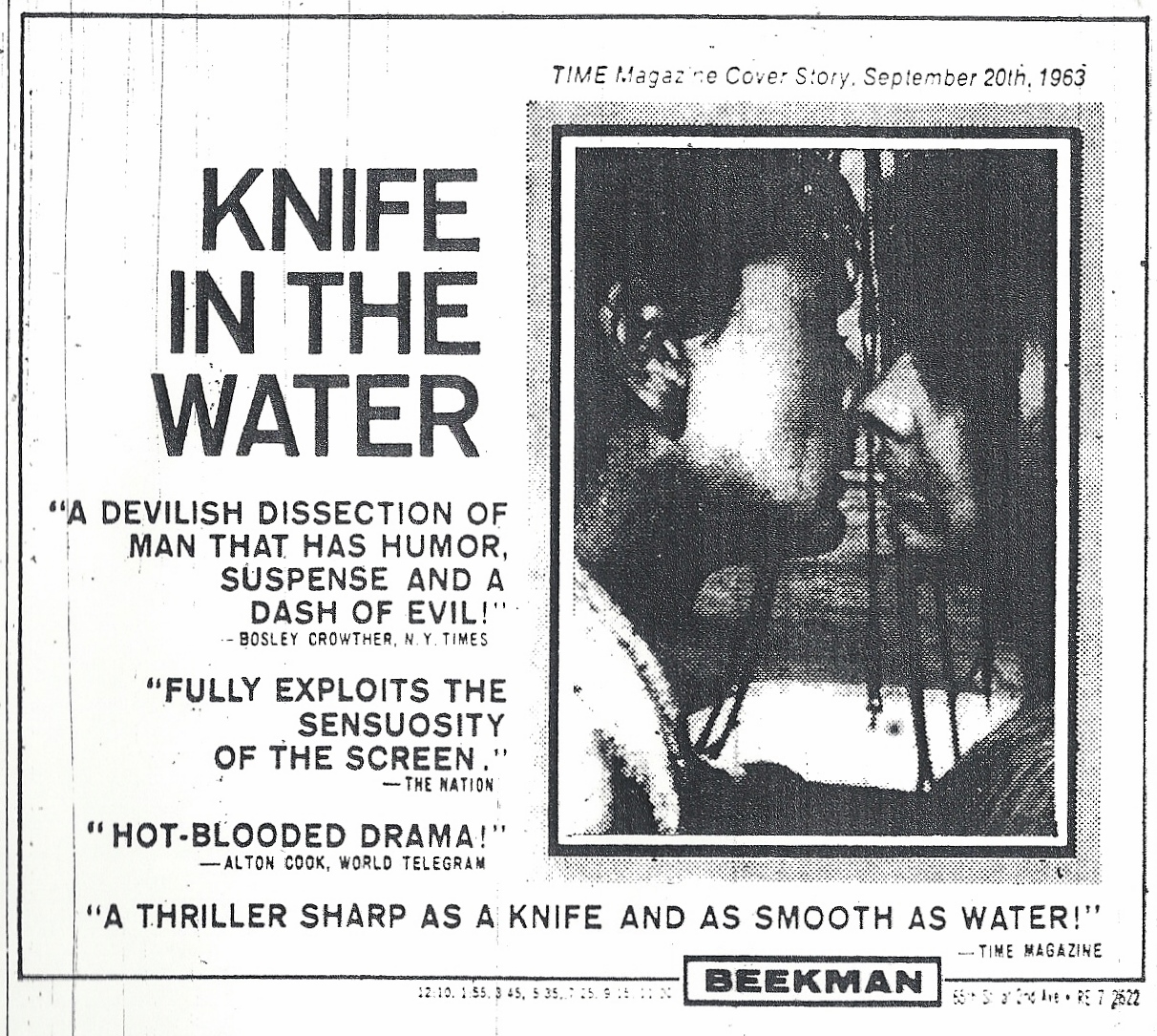
I've Just Seen: Knife in the Water (Nóż w wodzie) (1962)

Knife in the Water (Nóż w wodzie) (1962)

https://twentyfourframes.files.wordpress.com/2011/05/knife-in-the-water-ad1.jpg

Director: Roman Polanski

I look forward to seeing Polanski films. Chinatown and Rosemary's Baby are favourites of mine, and Macbeth and Venus in Fur were very good adaptations of plays. He gets great performances out of his actors, a skill that is evident in this, his first feature film. Knife in the Water thrusts us into a triangular scenario, as a couple invite a young hitchhiker to join them for a day trip on their boat.

I was most reminded of Rene Clement's Purple Noon: the isolated setting of the boat, the tension that lies under every scene: whether it is murderous or sexual remaining uncertain. We don't know why Andrzej invites the young man onto the boat, or why the young man says yes. Triangles crop up in a lot of the shot compositions: a character framed through the bent arm of another, the three of them placed at different distances from the camera, and the shape of the sail boat itself.

For the first half of the film one corner of the shape is a mystery: Krystyna. She is largely silent for much of the piece, and appears to be throughly uninterested in the conversations of her husband and the young man. However, she is not nearly so absent as we believe.

While not as brilliant as many of his other films, this is a very impressive first feature, and points to many ideas and themes Polanski would return to over the years.

Tuesday, 1 March 2016

I've Just Seen: A Girl Walks Home Alone at Night (Dokhtari dar šab tanhâ be xâne miravad) (2014)

A Girl Walks Home Alone at Night (Dokhtari dar šab tanhâ be xâne miravad) (2014)

http://static3.aintitcool.com/assets2012/aicncomics/agwhaan1.jpg

Director: Ana Lily Amirpour

Few films mix genres so readily as Amirpour's film. Part Western, part vampire horror, part romance, part gangster, set in a Iranian 'Bad Town,' all filmed in black-and-white. A Girl Walks Home moves through its story, giving its audience little sense of what is to come next; whether the next person The Girl looks at will be attacked, helped or seduced.

While I did not fall in love with the film the way many others have, it is was difficult not to be impressed by it. The film wears its feminism on is sleeve (or chador), but it fits naturally into the plot, and cleverly re-works the traditional male vampire/ female victim relationship we usually get. The cinematography is moody, most scenes taking place at night, lit by feeble street lights. The figure of The Girl walking around in the long, black chador already feels iconic, and she appears to float over the footpaths (at one point doing so on a skateboard).

I shall definitely revisit A Girl Walks Home, as it is a film that requires you to invest in it, with many scenes playing out without any dialogue at all. Gestures and expressions are the main forms of communication throughout the story, and can be missed if the film is watched casually. Dark and unique.