Friday, 13 February 2015

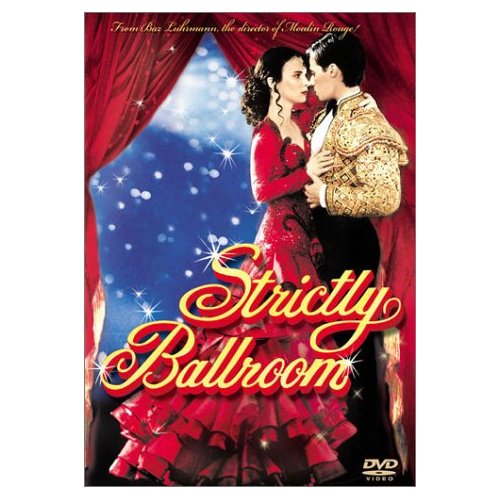
Great Southern Land Films: Strictly Ballroom (1992)

 https://cockingasnook.files.wordpress.com/2007/09/strictly-ballroom-cover.jpg


It is Valentine's Day in the merry old land of Oz, and despite not having reason to celebrate, being both single and rather cynical, I am using it as an excuse to look at one of the best Australian films with a sweet romance at the centre: Strictly Ballroom by Baz Luhrmann. 

I have history with this film (in a good way). In Year 10 for one of our English assessment tasks (a subject I love with every fibre of my being) we had to write a film review. Rather than getting us to watch a film on our own, them do it from home, the whole year spent half a day watching the film, then 45 minutes writing the review. Why Strictly Ballroom? Well, if you are Australian you have to encounter a certain amount of Australian content in the curriculum at school. It was a girl's school, so maybe they thought we would enjoy the camp and dancing (I certainly did). In this particular exam, I topped the year, getting 20/20 and had the honour of having my review read out. However, I was sick the day that happened, and had to experience my teenage bashfulness post-fact.

I did look through my old school work, but alas, could not find the test; it must have been thrown out in a fit of school-work purging. But I do remember using the word 'bombastic' (one of my favourite words) and referred to the fast-paced performances of Pat Thomson as mother Shirley and the late, great Bill Hunter as Barry Fife. We were not asked for five-star ratings, but I do believe I said I enjoyed it, and I probably would have given it five stars: it is a classic, and a very Australian one at that.

A confession, though really it is something that I have no shame about: I love a good dance scene, though poorly filmed ones are painful (show me some feet; keep the camera steady!). In my defence, I have been dancing (non-professional) for twenty years, trying a variety of styles. I have not done ballroom, but still love the dancing in this film. Because of his theatrical background Luhrmann understands how to film and frame a dance sequence: plenty of long shots, editing that keeps the continuity of the movement going, and the sequences actually contribute to the story.

The story has several plots, all of which are leading to the Pan-Pacific Grand Prix: Scott wants to do his own steps, Fran needs to emerge butterfly-like from underneath her glasses, Scott's Dad need to undergo a similar transformation, and Barry wants to stop Scott from doing his own thing. History is revisited, prejudices are broken, love blossoms, and all done as everyone wears sequins, ruffles and fluoro colours.

The central relationship between Scott and Fran is fuelled by their mutual love of dance. Scott is incredibly talented, while Fran is a beginner in the class, though clearly knows more about dance than she lets on. The best example of this is the 'Perhaps, Perhaps, Perhaps' sequence; despite being observed by all and sundry, there is a wonderful intimacy to the scene. Scott, rather than focusing on the dancing, is really enjoying being so close to Fran, who is relaxing into the movement, and only loses it when she notices Scott's ex-dance partner. 

The secondary characters are all played with great extravagance and, as my sixteen-year-old self noted, bombast by the cast. The two young children are very cute, acting as a Greek chorus to the activities of the adults. The humour is very Australian: laughing at kitsch whilst also enjoying it (much like our love of ABBA). The costumes add to the humour, they are both wonderful and tacky, the highlight naturally being Fran's pasadoble dress.

If you need an injection of fabulousness into your life, watching this in a triple billing with Muriel's Wedding and Priscilla, Queen of the Desert.

Wednesday, 4 February 2015

Great Southern Land Films: Based On: My Brilliant Career (1979)


 http://www.middlemiss.org/matilda/my_bc_film.jpg


In the 1970s Australia elected a progressive Prime Minister in the form of the late Gough Whitlam. His sweeping reforms of many aspects of Australian life included greater funding to the arts. The result was a boost of film activity which led to Australia experiencing its own New Wave along with many other countries. Gillian Armstrong's My Brilliant Career (1979) is an example of one of these films. It engages with contemporary (at the time) ideas about feminism, despite being based on a novel published in 1901.


The novel itself, though proffering some comment on women's place in the world, focuses just as much on the problem of living in a beautiful but fairly cultural-less part of the world. Sybylla Melvyn longs for a 'brilliant' career, be it music, stage or writing, and western New South Wales is rather scant on that. Her family has come down from being respected farmers to barely surviving off the land. She is invited to stay with her wealthier grandmother at Caddagat, where she meets Harold Beecham, a young farmer owner who appears to be interested in our uncouth heroine.

The film heightens the romance of Harold and Sybylla's relationship. In the book, Sybylla is certain that she will never marry, and only promises to marry Harold when she thinks she may be of use to him; hardly a romantic reason. In the film, the temptation appears to be greater. There is more physical contact between the two. The sound also adds to the romantic vibe; when Sybylla and Harold are having a pillow-fight (a scene not in the book), we hear sweet song as they run through picturesque gardens. There is also a scene of romantic kissing at sunrise by a river.

One could argue that the love story in the novel is not very romantic. Very little 'romantic' language is passed between Sybylla and Harold. It is more a battle of wills, and Sybylla trying to live according to what she knows about herself. She also hates being touched, and Harold only comes close to kissing her once towards the novel's end.

As with any film set in a historical past, the costumes come to the fore; we are highly aware that these characters are living in a different period. This creates a distance that is less overt in the novel. We are thoroughly ensconced in Sybylla's first person narrative that the reader sometimes forgets what era with are in, only noticing when she talks about carriages or the ball. In the film, in any film that is set in a historical past, you are always aware about the time period.

The costumes also add to the romance of the story. Almost every period drama has some element of romance, if not being the actual subject of the story. Lace, bouffant hair-dos, corsets, structured suits and men on horses play into the romantic imagination. Of course, this film does occasionally undercut some of the romantic moments. Sybylla deliberately undermines a cliched romantic moment on a boat; just as they are gazing into each others eyes she capsizes the boat, ruining the moment, and their clothes. The squalor of Sybylla's actual home and at M'Swat also undermines this romantic image of the past, reminding us of what life was like for most people.

The greatest change from the novel is the ending of Sybylla's life working as a teacher/governess. In the film Mr and Mrs M'Swat believe that Sybylla is setting her cap at their eldest son; her open, chummy-ness being misconstude again. In Franklin's novel however, Sybylla becomes increasingly ill living with the family. She is physically, emotionally and spiritually starved. The M'Swats are kindly concerned for her welfare and send her home, dismissing the debt Sybylla's father owes them. Why change it, you may ask?

The film wears its feminism on its sleeve, and engages with the narrow avenues of life available to women more overtly. Enhancing the romance makes complicates Sybylla's desire to be independent, offering her a very tempting path for the more traditional life. In the novel, Franklin presents Sybylla as someone who would not cope with the drudgery of living in an uncultured backwater. In marrying Harold, she would still be stuck on this part of the world, though better off then many others.

This is an interesting story that explores the unease of a culturally hungry woman living in the harshly beautiful Australian outback, putting it in the second of my Australian film categories (for a refresh, go here).

Sunday, 25 January 2015

Great Southern Land Films: The Castle (1997)


The Castle - Australian movie quotes
As you can tell from that write-up, the film falls squarely into the suburban category of Australian films. However, the suburbs are not presented as a soul-crushing place to live, but is celebrated for its sense of community. Darryl is not only fighting for his home, but also his neighbours, two of whom are Lebanese immigrants. There is gentle satire about the obliviousness of the Kerrigans, who don't realise their lack of taste or culture. But it is not a negative thing; the Kerrigans are a happy family who care and love each other without judgement. Even Wayne Kerrigan, in gaol for armed robbery, is still part of the family.


It is Australia land in the land of Oz (it is 26 January here), and what better way to celebrate than with a cracking local classic: The Castle (1997). Directed by Rob Sitch, written by Sitch, Santo Cilauro, Tom Gleisner and Jane Kennedy, this presents an hilarious take on the old David-and-Goliath story. It is an early role of Eric Bana, and also stars Michael Caton, Anne Tenney, Tiriel Mora, Stephen Curry, Sophie Lee ('beautiful' Tania from Muriel' Wedding) and the late, great Charles 'Bud' Tingwell.

A suburban Melbourne family, the Kerrigans, live in gentle contentment near the airport. They are upper-working-class who think they live in the greatest place in the world. One day, a property valuer comes to inspect, and the whole street is later presented with a compulsory acquisition order; the airport is planning an expansion project. Darryl Kerrigan, head of the family, decides to fight it, on the principle that 'a man's home's his castle' and he should be allowed to defend it. He gets all the way to the High Court of Australia with a little help from small time lawyer Dennis Denuto and QC Lawrence Hammill.

When Darryl meets Lawrence, he doesn't see any disparity in their lives, though he concedes Lawrence is more intelligent. Lawrence also recognises this quality of the Kerrigan family, and believes it to be worth defending. Australians like to think of themselves as egalitarian, and this film celebrates that idea.

This is the Casablanca of Australian films; many of its quotes are now part of the Australian vernacular. 'How's the serenity!' is an exclamation of contentment, usually used when holidaying in Bonnydoon. 'Tell'm he's dreaming!' is used with scoffing derision upon hearing someone's ridiculous offer on your boat or any object you are selling. 'That's going straight to the pool room' denotes a cherished object, like a handmade mug. 'It's Mabo, it's the vibe' should be used when positing a feeble argument why something is unfair.*

I cannot honestly say how this film would be received by non-Australian audiences. It is very well-loved here (and I am surprised that it is not showing on free-to-air television today) for its representation of Australian life; how much of it translates would be interesting to see. According to Wikipedia, it was shot over 11 days, and was made for the grand total of $75 000. It made $10.3 million in Australia; clearly, it went straight to the pool room!

*A court case that recognised native title land rights in Australia. For more information: https://en.wikipedia.org/wiki/Mabo_v_Queensland_%28No_2%29

Saturday, 17 January 2015

Great Southern Land Films: The Tree (2010)


 http://upload.wikimedia.org/wikipedia/en/4/4c/The_tree_poster.jpg


The Tree (2010) is an Australian-French co-production, based in Judy Pascoe's novel Our Father Who Art in the Tree. After Simone's father, Peter, dies from a heart-attack in his truck on the family's property in southern Queensland, she believes that his spirit now inhabits the giant Morton Bay fig tree that is rooted near the house. Tension occurs when Simone's mother, Dawn, begins seeing a plumber. As the tree drops branches on the house, and its roots threaten the plumbing and structure he suggests that they cop it down.

This film falls into the spiritual outback category of Aussie films. It has a lovely lyrical quality, with its close-ups of the elephant-like bark of the tree. At the top of the tree's trunk is a platform that Simone and her mother snuggle into on occasion, the branches embracing and holding them. The breeze in the leaves whisper responses to Simone's own whisperings. Parts of it reminded me of the close-ups of nature in Nicolas Roeg's Walkabout, but with a less visceral overtone.


The Tree is an obscure Australian film, despite the calibre of the cast, particularly Charlotte Gainsbourg and Marton Csokas. It is also a French-Australian co-production, a permutation that rarely occurs.

The use of the tree is clever way to explore different responses to grief. Dawn (Gainsbourg) remains deep in her grief for the first half of the film. She can't keep the household together, instead relying on her older son to pick up the slack. Simone (Morgana Davies) is eight, and one could argue that her belief in her Dad's present spirit is misguided, but the film doesn't condescend to her. In fact, it sticks close to her viewpoint, offering no definitive answer to this belief.

After Dawn emerges from her grief after she begins working for a local plumber, played with rugged temptation by Marton Csokas. One night, the tree drops a huge branch into her bedroom; instead of getting angry, Dawn gets into bed, surrounded by the strong branches and leaves and feels comfortable and happy. She, like Simone, feels closer to Peter through the tree.

This complex and intelligence exploration of grief is bolstered by what I consider the film's greatest drawcard: the wonderful, and wonderfully named, Morgana Davies. She is the film's emotional backbone, a weight that her young shoulders carry with aplomb. Her performance is one of the best child performances I have ever seen, and if the topic doesn't interest you, I would urge you to see simply for her.


http://graphics8.nytimes.com/images/2011/07/15/arts/TREE/TREE-articleLarge.jpg


The rest of the performances are strong as well; Charlotte Gainsbourg is very good as the grieving wife and mother, and handles the vacillating aspects of the character well. Marton Csokas is also good as the outsider who disrupts the family unit. The children are all good, and the dynamics between them are recognisable.

It is not a huge film, but I really enjoyed it; it is quietly beautiful and deep, with a wonderful depiction of Australian country life at the heart of it.

So, has anyone seen it?

Tuesday, 13 January 2015

Great Southern Land Films: Double Feature: Muriel's Wedding (1994); The Adventures of Priscilla, Queen of the Desert (1994)

I have decided that for the beginning of this year I will do a blog series on Australian films. There is no greater reason for this, except that I myself am Australian, and think that our film industry has, and continues to produce some great films. Though a few break through to receive international acclaim, many remain in obscurity. This series, which I am calling 'Great Southern Land Films,' will be a mixture of the famous and the hidden gem.

I have a theory, a very unscientific one, that almost all Australian films can be slotted into two categories: life in the suburbs, and life in the outback (or bush). Films that explore suburban or even city life may engage with themes of alienation, isolation, conformity with either a dark or humourous approach. Films set in the outback often deal with our relationship to the land. There are two subsections to this category: Aboriginal people's complex spiritual connection with the land, and Europeans' problematic engagement with it.

 http://content8.flixster.com/movie/11/15/32/11153218_800.jpghttp://ia.media-imdb.com/images/M/MV5BMTgyMzgwNDMwNV5BMl5BanBnXkFtZTcwNTAwMzAzMQ@@._V1_SY317_CR3,0,214,317_AL_.jpg

Muriel's Wedding falls into the suburban Aussie film category, while Priscilla, Queen of the Desert is a mixture of the two, as it deals with a trio of suburban Sydney-siders, two drag-queens and one transsexual, driving into the red centre of Australia. Both films tackle the idea of alienation: Muriel attempts to escape her feelings of alienation associated with Porpoise Spit by going to Sydney to live with her friend Rhonda; Tick, Adam/Felicia and Bernadette enter a land that is like another planet to them, and to the locals they appear to be aliens (at least at first).

Muriel feels different from the other girls in her 'friendship' group. Pretty, thin, and commonly blonde, they constantly belittle the more dowdy Muriel. The scene where they drop her from the group is a wonderfully grotesque, as Muriel bawls in front of them. (Coincidentally, this is one of the best actual crying scenes in a film. Most women in films 'movie-cry,' which means no blotchy face, no open wail, and no runny nose.) Muriel's own family ostracise her; 'You're terrible, Muriel' is a common phrase in the Heslop household.

Tick, Adam/Felicia and Bernadette are not outsiders in Sydney, but are completely bamboozled by outback Australia. As Bernadette tells Adam/Felicia:
"It's funny. We all sit around mindlessly slagging off that vile stink-hole of a city. But in its own strange way, it takes care of us. I don't know if that ugly wall of suburbia's been put there to stop them getting in, or us getting out."
 Interestingly, an Aboriginal group enjoy their performance, but the white locals are far less kind. Adam, dressed as Felicia, goes looking for sex with a group of young men who are less than impressed to find the fit and willing woman is actually a bloke. The culture of rigid gender stereotypes finds its zenith with the ping-pong ball scene in the bar. Cynthia Campos' trick may require more skill than the ability to dress up in flamboyant costumes, but it is far less tasteful and clever. (The character of Cynthia Campos is one of the films' only drawbacks. It borderlines on being racist and sexist). Female sexuality is objectified in her performance, while the gender-bending drag queens are trying to provoke and undermine assumptions based on such stereotypes. The local men know which they are more comfortable with.

Conformity is explored through the institution of marriage in both films. Tick reveals that he is married to the woman who runs the Lasseter Hotel Casino, a circumstance at odds with his current lifestyle, and his sexuality. He also has a son, whom he hasn't seen in years. Adam and Bernadette find his conventional background rather hard to process; is he straight, or gay? Tick's answer is 'I don't know.' Tick wonders what his son is going to think, and whether he will accept his unorthodox lifestyle. The ending to this storyline is very heartwarming.

Muriel spends much of the film wanting to be a bride, believing that marriage will solve all her problems and make her happy. Her glitzy wedding is all she ever wanted it to be, but she has ruined her friendship with Rhonda. Even though Muriel's husband begins to value her as a person, she chooses to rescue Rhonda from suburban drudgery. The last scene of the film is of them saying goodbye to familiar Porpoise Spit places, driving off into an unknown future. Muriel has broken with the traditional idea of feminine happiness, choosing friendship over marriage.

It is interesting to note that most of the posters (such as the one above) for Muriel's Wedding (and DVD covers too) featured a shot of a beaming Muriel decked out in a wedding dress, being showered by confetti. I wonder how many people were surprised by the film's feminist ending.

 Both Muriel and Priscilla are films that present people throwing off the shackles that bind them to conformity and embracing the path less chosen. Perhaps this quality of self-expression in its characters find no greater example than in both films use of ABBA. Reader, you may not know this, but Australia has the biggest fan base for ABBA outside of Sweden. We love their music, and are the home of the parody cover band Bjorn Again. ABBA is mentioned throughout both films: they are Muriel's favourite band, and feature heavily on the soundtrack. Muriel at one point says:
"When I lived in Porpoise Spit, I used to sit in my room for hours and listen to ABBA songs. But since I've met you and moved to Sydney, I haven't listened to one Abba song. That's because my life is as good as an Abba song. It's as good as Dancing Queen."
In Priscilla, Bernadette is constantly decrying Tick and Felicia's love of the group.

ABBA songs are a show piece in each film: Muriel and Rhonda perform Waterloo at a Talent Night while on holiday, while Tick/ Mitzi and Adam/Felicia do their best Anni-Frid and Agnetha impressions for Mamma Mia.


http://www.rockymusic.org/img/priscilla/Priscilla-FeliciaMitziMammaMia2L.pnghttp://img2-3.timeinc.net/ew/i/2013/06/24/Muriels-Wedding.jpg

Inside every Australian, be they male, female or both, is a desire to mime along, in costume, to ABBA.

Factoid: the idea for Priscilla came when Stephen Elliot heard someone refer to a drag queen as a 'cock in a frock.' His mind moved in mysterious ways, and came up with the phrase/idea of 'a cock in a frock on a rock.'

Another is that the late national treasure, Bill Hunter, is in both films: his is Muriel's slimy politician father; and the open-minded, tender Bob. 1994 was obviously a busy year for him!

Wednesday, 10 December 2014

Apologies, Hopefully Normal Service Shall Resume Hereafter

Many apologies for the unscheduled hiatus.  

I was briefly transported back to the dark ages of the 20th century when a rogue boat anchor tore up communication cables near my suburb, leaving 100 homes without Internet or telephone capabilities for three weeks (and that is not counting the one week earlier in November). It also doesn't help that I live in a beautiful but slightly isolated part of Australia, a part that is known for its poor mobile phone (cell phone) coverage as well.

Essentially, we were more cut off from civilisation than usual.

On the plus side, the television still worked and I was able to watch a ton of films during the period. I saw thirty films in the month of November (thank you local library!), and knocked off a few of my blind spots: Reservoir Dogs, Avatar, Melancholia, Schindler's List, Saving Private Ryan to name a few.

Having started the year having only seen around 600 films in my lifetime (according to my memory) I have, as of this date, got that number to 896, meaning I will easily reach my target of seeing 900 by 31st December. (I keep a spreadsheet, hence the exactness of my figures).

Since this time of the year lends itself to reflection, I thought I would bore you with some of my thoughts about my film watching over the year. I have learnt a lot. I have immersed myself in film history, adding phrases like 'French New Wave,' 'Social Realism,' and 'agitprop' to my vocabulary. I learnt to appreciate and love people like Stanley Kubrick, Jane Campion, Ang Lee, and Ingmar Bergman and discovered previously unknown delights in Andrei Tarkovsky and Krzysztof Kieslowski.

Having begun a personal course of study into the art of screenwriting, I have a much greater depth of understanding in regards to story. You would think that this might lead to cynicism and snobbiness, but thankfully its effect has been to sharpen my appreciation of a well-written story, to inwardly gasp at the mastery of Charlie Kaufman's Eternal Sunshine of the Spotless Mind, Nora Ephron's When Harry Met Sally and Fritz Lang's M amongst others.

Though the title of favourite film/s has not changed hands, a huge number have been added to the mental list this year: 2001: A Space Odyssey, Psycho, Trois Coleurs: Bleu, Deliverance, Rosemary's Baby, Alien, Aliens, Klute, Volver.

But my recommendation from this year is not a film but a film history documentary and companion book. If you can, grab/ borrow a copy of Mark Cousins' The Story of Film. I read the book first, which was a great initiation into film history. The documentary, however, was fabulous; 15 one hour episodes taking us from the invention of cameras, to musings on the future of the film industry. I was educated and inspired.

So, dear reader, what were the standouts of your year of viewing?

Saturday, 15 November 2014

Double Feature: Rosemary's Baby; Alien


http://upload.wikimedia.org/wikipedia/en/c/c3/Alien_movie_poster.jpg http://upload.wikimedia.org/wikipedia/en/e/ef/Rosemarys_baby_poster.jpg


 Warning: blah blah blah, spoilers, blah blah blah.

I would not call myself a horror film fan; I haven't seen many and don't really find them that scary. My inner cynic comes out when watching the jumpy ones; the longer the silence lasts, the likelier a 'scare' is going to happen. The horror films I have enjoyed are not simply out to scare you; they deal with other issues like family, and our relationships with the 'other.' Or they are campy fun!

Roman Polanski's Rosemary's Baby (1968) and Ridley Scott's Alien (1979) are intelligent horror films that have very different approaches to the experience of pregnancy and birth. Based on Ira Levin's novel, Rosemary's Baby tells the story of Rosemary Woodhouse and the strange goings-on that happen while she is pregnant with her first child. At the time of conception she seems to have a dream that the devil rapes her as she is surrounded by her neighbours and her husband. Rosemary famously declares 'This isn't a dream! This is really happening!', but her husband dismisses the scratches on her body as a consequence of rough sex the night before. The growing foetus makes her very sick, but when Rosemary believes her neighbours are trying to harm her child she is very protective. The birth is as obscured as the conception, and Rosemary is kept in the dark about the whereabouts of her baby. The last scenes reveals two twists: one, that baby is the antichrist, and two, Rosemary loves it anyway.

Scott's Alien is both science fiction and horror. It could easily be a group of people stranded in an isolated cabin dealing with a pesky intruder; its being set in space adds another layer to the story. The characters are as isolated as humans can get in the universe, travelling on a ship that is far from earth. A team aboard the Nostromo, which is heading back to earth after a mission, receive a distress call from a nearby planet. One of the crew, Kane, who go exploring the planet is attacked by a strange creature that comes out of an egg. It remains attached to his face; it does not kill him but uses his body as a host (the crew is not sure what for). It eventually drops off and Kane wakes up with no memory of what has happened. In the of the most famous scenes in film history, an alien bursts out of his stomach at mealtime. It proceeds to terrorise, and kill, all crew members on the ship, save Ripley who escapes via a shuttle.

Pregnancy has been used as a dramatic point in every genre of film. What makes horror different from others is its emphasis on and exaggeration of the violence of this natural experience. Rosemary's body is taken over by her growing child; during the first few months Rosemary grows considerably thinner, and she is struck with almost unbearable pain. This is comparable to the alien's attaching itself to Kane; he is acting as a host for the alien. It is not in its interest to kill him, but it renders him completely immobile and unconscious. They can't separate the alien from Kane without killing him. Both Kane and Rosemary are acting as hosts to these dependent creatures.

Of course, these 'creatures' are not your typical foetus. Kane's alien baby is organic looking but clearly not human. Beyond him acting as a host Kane means nothing to the alien; there is no 'love' between them. It kills Kane when it is born. With Rosemary and her baby, the normal mother-baby bond is less straightforward than usual: the child is the Devil's Son. The people around Rosemary also view her as a host for the child. Minnie Castevet, neighbour and devotee of the Devil, keeps giving Rosemary tonics to help with the baby's growth. Though throughout the film people appear to be caring for Rosemary, everyone is actually focused on the unborn baby. Strangely enough, Rosemary is as well, even when it is causing her great pain.

One of the most striking scenes in Rosemary's Baby is a moment after a party Rosemary and her husband have hosted at their flat. For the last few weeks Rosemary has looked sickly: pale, she has lost weight, and she is crippled through pain. To top it all off, the foetus is not moving. After the party she fights with her husband about getting a second opinion about her pregnancy. Suddenly the pain stops. Then Rosemary starts smiling. 'It's alive!' The foetus is moving, and she is far happier about that then about being free from pain. There is something both understandable and yet highly uncomfortable about this response. While she is full of joy at the life inside her, Rosemary still looks like death with her gaunt, pale face. At what cost is this child being kept alive?

 It is interesting to note the presence of rape in both these pregnancies. Rosemary has a dream where she is raped by a monstrous figure, watched by her husband and neighbours. She wakes with scratches on her body. Her husband explains it by saying that, despite Rosemary being unconscious, he didn't want to miss a chance for them to get pregnant, and got a bit carried away. She may have wanted to get pregnant, but Rosemary is deprived of her ability to choose when (and with whom). 


Kane clearly doesn't have any choice in what happens to him. The alien attacks him, and latches on to his face. His face is obscured by the creature; it takes away his identity, as well as only keeping him alive to keep itself alive. 


One could question the behaviour of Kane, touching a strange object that looks like an egg while exploring an alien planet. But curiosity is a human trait, and without it the film (and many others) would not last beyond Act One.

These rapes are not performed because of unbridled sexual desire or as a display of power over a character, the common reasons for rape. Instead they are objectified as hosts, seen as simply a place to live in for a period of time. It is notable that in Alien it is a man that is raped and impregnated; Dan O'Bannon (screenwriter) argued that it was intended as 'payback' for all the women in horror who preyed upon by male creatures.* You could argue that this is a display of power by the alien, but it does not specifically target Kane, only latching onto him because he is there. Likewise Minnie and her husband and their friends use Rosemary because she is close by. This adds to the horror of the situation; they are not special, just convenient objects for others to use.

The pregnancies in Rosemary's Baby and Alien are animalistic in their violence, treating the 'mother' as nothing more than a host. There is no love exchanged, though Rosemary does love and care for her child; it being the Devil, it is unlikely to love her back. Of course, normal pregnancies are (hopefully) less violence. However, the writers and filmmakers are cleverly exaggerating aspects of human pregnancies and birth. The outcome is usually happier, as one doesn't have an alien kill you, or give birth to Satan's Son, but there are uncomfortable, painful, even traumatic occasions in even the most normal of pregnancies. Unlike horror films about being possessed by spirits, or body horror that explores transformations (werewolves or vampires), these two films play upon a very real experience. It is this that makes them so unsettling.