Tuesday, 7 April 2015

Based On: The Big Sleep


http://www.filmsite.org/posters/bigs2.gifhttp://blogdailyherald.com/wp-content/uploads/2014/10/tbs.jpg

'I'm a licensed private investigator and have been for quite a while. I'm a lone wolf, unmarried, getting middle-aged, and not rich. I've been in jail more than once and I don't do divorce business. I like liquor and women and chess and a few other things. The cops don't like me too well, but I know a couple I get along with. I'm a native son, born in Santa Rosa, both parents dead, no brothers or sisters, and when I get knocked off in a dark alley sometime, if it happens, as it could to anyone in my business, nobody will feel that the bottom has dropped out of his or her life.'

Quite a character to have as your moral centre. Yet this is what Philip Marlowe is in Raymond Chandler's novels: he works to discover the truth, who killed who, why and will they do it again. In The Big Sleep, the first story featuring Marlowe, we follow our detective as he investigates a blackmailer who is targeting the wild daughters of General Sternwood. The book was released in 1939, with Howard Hawks' film adaptation following in 1946. The novel is a hardboiled crime novel, which translates into a film noir on the screen.

http://static.tvtropes.org/pmwiki/pub/images/The_Big_Sleep.jpg
The starkest difference between Hawks' film and Chandler's novel is the relationship between Marlowe and Mrs Vivian Regan (in the film Vivian Rutledge), General Sternwood's oldest daughter. In the book Marlowe interacts with her about four times in total: at the Sternwood house, his office, the gambling house and once again at her home. The movie includes Vivian in more scenes, and even creates one at a restaurant. There is an obvious answer to this: the studio wanted to capitalise on the chemistry and notoriety of Humphrey Bogart and Lauren Bacall, who played Marlow and Vivian.

https://flavorwire.files.wordpress.com/2011/06/bogart-bacall1.jpgThe chemistry is there in spades, particularly in the restaurant scene and later in a car. Bogie and Bacall spark off each other, but there is also a genuine sense of affection: they care for each other. In the novel, while Vivan does try to seduce Marlowe, he carefully rebuffs her (after accepting a few kisses). This change in their relationship drastically changes the outcome of the story and the projection of Marlowe's character.

Marlowe ends Chandler's novel feeling wistful not for Vivian, but rather Mona Mars, the beautiful woman that has been missing for most of the novel. The last line of The Big Sleep is 'All they [the alcoholic drinks] did was make me thin of Silver-Wig, and I never saw her again.' There is a great bitterness and sadness in this line. Marlowe has something of the courtly knight about him; his quest is always to uncover the truth, and he occasionally becomes attached to the women caught up in the plots. Mona 'Silver-Wig' Mars was a bit of a damsel in distress, and Marlowe's sense of decency responded to her.

This is the last shot of the film:

http://i191.photobucket.com/albums/z43/sevenarts/cinema/bigsleep.jpg

Marlowe isn't so alone now, is he! Not only is Vivian with Marlowe at the end, she is the one who saves him from Canino, not Mona Mars (who is there but leaves in a huff after Marlowe says some nasty things about her husband). The love scene in the car is more romantic than in the novel as well; it is not simply an exchange of sleazy kisses but sincere declarations of love.

The result of this change is that Marlowe changes as a character during the film. He begins as the cynical Marlowe from Chandler's novel, but at the end has found love with another. They both know the truth about each other and rather than being repulsed, are actually drawn together. Chandler's Marlowe ends the novel perhaps even more jaded than at the beginning; most of his views of life have been reinforced, not challenged.

The reason for this change is down to both the audience expectation. As previously mentioned, Bogie and Bacall were famous for their chemistry, and the audience would have wanted to see them together at the end, just as they were in their first film together To Have and Have Not (1944). It is interesting to note that nowdays audiences would protest at such a pandering alteration being made to such a great book. However, this change allows the two texts to stand on their own and be enjoyed separately. The novel is a great piece of hardboiled fiction, the film a great example of film noir.

Do you agree? Can a film change enough of the story to be its own text, or are you a purist?

Thursday, 2 April 2015

Some reflections on Adaptations

I have a great interest in film adaptations of literature, as evidenced in my 'Based On' series of posts. Adaptations are an interesting beast in the world of film. They often have ready made audiences who look forward to seeing their favourite books/plays/comics presented with all the magic of film: this audience, however, approach the film with a highly critical eye. Adaptations get received differently depending on what type of adaptation they present of the text, as well as the original text's status within current culture. Popular bestsellers are treated differently to 'classics,' which are again treated differently from biography or stories from history.

There are several different types of adaptation. The most common approach assesses the film's faithfulness to the original text. How many scenes and characters are included? Do the characters resemble the author's descriptions of them? How much dialogue is included from the original text? In this reading the original text casts a shadow over the film; everything is viewed in how it relates to the book. Inevitably the film comes off second-best to the book.
http://content.internetvideoarchive.com/content/photos/7239/30405805_.jpg
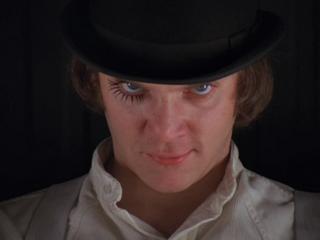
'There was me, that is Alex, and my three droogs,'
This is the main way fans examine this films; they are purists. The movie doesn't have their favourite scene, or line of dialogue, or the characters don't look the same; therefore it is somewhat wrong. While this reaction is understandable, overall I think this is the wrong way to approach film adaptions. The idea that a film could ever be as the original story was is foolish. On a most basic level films are visual, and books (the mostly commonly adapted sources) are word based. They also have different tools they use to convey meaning: books can give detailed explanations of a character's inner life; films, unless they use voice-over, have to find other ways to probe character depths. A well executed example of this is Stanley Kubrick's A Clockwork Orange which included Alex's first-person narration from Burgess' novel, giving us intimate access to the character's thoughts.

https://s-media-cache-ak0.pinimg.com/736x/d4/dd/29/d4dd29d6bcfea6f9a017c48d240fd79b.jpgFor adaptations of stageplays, the space the story plays out in is the greatest change. In film you can put your characters in any setting you want and make it look realistic. You can move from a tiny cramped room to outer space (sometimes in the same shot). On stage you are limited to the space of the stage, and dialogue is often used with scenery to represent the setting.


https://d.gr-assets.com/books/1327955958l/437131.jpg
“Were I to fall in love, indeed, it would be a different thing; but I have never been in love ; it is not my way, or my nature; and I do not think I ever shall.”
Not all adaptations aim at faithfulness. Denise Faithfull in Adaptations* lists three others: variation, appropriation and intersection. Intersection is the attempt to 'absorb' the original text into cinema; to find visual, aural and verbal correspondences to the original text's language, rhythms, patterns and tone. The first two types don't treat the original text's as sacred, untouchable sources but choose to play around with them a bit. Amy Heckerling's Clueless is an appropriation, setting Jane Austen's nineteenth century novel Emma in 90s California.

For me, the most interesting adaptations of novels or plays presents a particular reading of the text.  This doesn't mean an academic reading, but rather one that follows a particular theme, or chooses one genre to pursue (focus on the drama, comedy, romance, etc.). Because novels tend to have far too much material to include in a film (or even a series of films), the screenwriter, producer, and director have to make choices about what and what not to include. If the filmmaker is serious about making a cohesive film, the choices must be based around the chosen theme or emotion. An example of such choice is the Harry Potter films: the detail about everyday life at Hogwarts, homework, exams and classes, were largely excised from the finished films. They were only included when they provided information essential to the Voldemort/Harry plot. As a result the books feel darker and more serious than the novel, which have episodes and B-plots that provide comedy.

Filmmakers should heed the advice of Orson Welles, a prolific adaptor: 'you must say something new about a book, otherwise it is best not to touch it.'

How do you approach screen adaptations? Are you a purist or an anarchist (or somewhere in the middle)?

*Denise Faithfull (with Brian Hannent), Adaptations, Currency Press: Sydney, c2007.

Friday, 20 March 2015

Close Up: Marilyn Monroe

 http://www.metmuseum.org/toah/images/h2/h2_2002.379.11.jpg


Marilyn Monroe is famous for her 'dumb blonde' roles, performances that influenced her public persona. She was seen as a unbelievably sexy and good-looking, but rather naive about it, with a sweetness of manner that avoided vulgarity. She was also notoriously difficult to work with, often coming late to set (if she turned up at all), and had many issues with alcohol and drugs (but hey, it's Hollywood, who doesn't!). However, Monroe was a fine comic actor, with a good sense of timing and she not afraid to look daft. These four performances show that while she was often typecast, she did bring subtle differences to these roles.

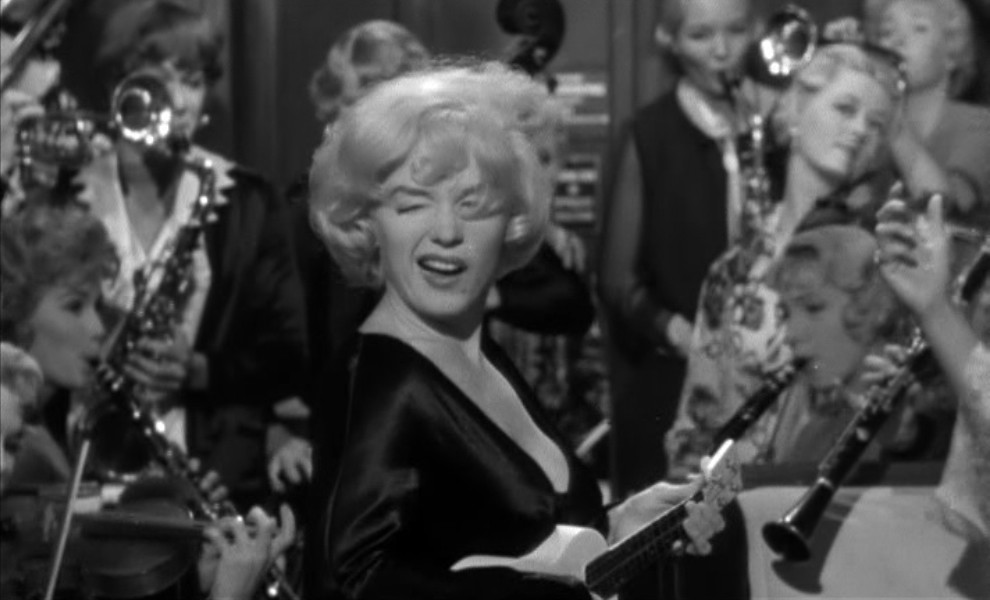
Some Like It Hot
 https://farm7.static.flickr.com/6210/6054630628_9d4cc6fa00_b.jpg
This film is a great example of ensemble acting; everyone is on their game and each supports the other's performance. This is true for Monroe, who is the sexy and sweet Sugar Kane, a great foil for Tony Curtis' 'Joe-sephine' and Jack Lemmon's 'Gerald/ Daphne.' I am unsure about calling this a 'dumb blonde' role. Though Sugar tells us she 'not very bright,' her slight aura of melancholy gives her a bit of depth. The number 'I'm Through With Love' best captures this, as she sings about yet another heartache. Considering how difficult the shoot was for all involved, the polish and joy of the finished product, particularly Monroe's performance, is amazing.

Gentlemen Prefer Blondes
http://ourgoldenage.com.au/wp-content/uploads/2014/02/GAC_GentlemenPreferBlondes.jpg
Lorelei Lee is a quintessential dumb blonde; she gets stuck in a porthole, does not know where to wear the diamond tiara ('I just love finding new places to wear diamonds'), and she accepts the diamond tiara as a gift without considering the consequences (the man's wife presses charges!). Gentlemen allows Monroe shows off her singing abilities; she was not brilliant, but certainly competent. Comedy is notoriously difficult to get right, and Monroe is very funny in this film. The porthole scene always makes me giggle. Jane Russell, as Lorelei's friend Dorothy, does a great impression of Lorelei, which is really an impression of the Monroe persona.


Bus Stop
 http://images6.fanpop.com/image/photos/36600000/bus-stop-1956-marilyn-monroe-tribute-36648168-668-1000.jpg
It has been several years since I saw this, but I remember it being a change of approach for Monroe. Her character, Cherie is a rather poor singer working in a bar. Monroe gets the uncouthness of Cherie just right, while also giving her depth; she is determined to be respected by the next man she loves, and refuses to bow to cowboy Beauregard's bullying behaviour. When one considers the musical number early on, one sees the abilities of Monroe. Her rendition of 'That Old Black Magic' is terrible, her voice struggling to hit the high notes. Monroe can sing, as demonstrated in many of her other films; her deliberately bad performance is great piece of acting. 

The Misfits
 http://upload.wikimedia.org/wikipedia/commons/4/4e/Marilyn_Monroe_in_The_Misfits_trailer_2.jpg
Monroe plays newly divorced Roslyn Tabor who falls in with a group of mustang hunters in Nevada.  There is palpable pain in this performance, as Roslyn comes to terms with the anger and violence of the men she is with, particularly Clark Gable's Gay, with whom she is falling in love. The most striking moment in the film is Monroe running away from the men on the dried-up lake, calling them beasts in their treatment of the wild horses. Similarly to Some Like It Hot, there were many problems on set, one of them being the breakdown of Monroe's marriage to Arthur Miller. The pain and vulnerability of her performance is definitely inflected with this event.

Do you have a favourite Marilyn Monroe performance?

Tuesday, 10 March 2015

Double Feature: The Birds (1963) and Jaws (1975)

 http://ecx.images-amazon.com/images/I/71CTreJGV5L._SL1500_.jpghttp://media.zenfs.com/en_US/News/US-AFPRelax/birds_xlg.0503d093428.original.jpg
What would happen if birds suddenly began attacking a small town?

What would happen if a mega shark suddenly began terrorising a small island town?

Or, what would happen if nature began acting in a way that threatened our normal (human) way of life?

This question is the basis for Alfred Hitchcock's The Birds (1963) and Steven Spielbergs' Jaws (1975). These famous, pithily titled films focus on the sudden threat posed by previously unproblematic creatures: the bird population of Bodega Bay, California in The Birds, and Amity Island in Jaws. While behaviour such as attacking and killing people is expected of sharks, Jaws makes it clear that this shark is like none seen before: it's huge, highly territorial and most frighteningly, stealthy.

It is interesting to try and classify these films' genres. Wikipedia lists The Birds as a suspense/horror film, while Jaws is a thriller. However, Jaws is also a suspense/horror film, particularly when one considers the impact it had on audiences, making many think twice about going into the water again. If horror films take aim at our most primal fears then surely Jaws and The Birds are examples of the genre. Surely there is no greater primal fear than being attacked by wild animals, a fear that is rooted in our evolutionary history. It takes us back to hunting and gathering, where humans were at risk of being prey to other creatures. Personally, I find these types of horror films more scary than gore or supernatural pieces.

There are also elements of the disaster movie: the problem that besets these towns is natural (of nature), and there is a moral undertone to the story. The birds first attack Melanie, who is the beautiful outsider and threatens to disrupt a part of the town's life. They don't kill her, but she is left severely disturbed. The iconic last shot, where Mitch and his family take her away is terrifying for its stillness; the birds don't react, but let the group leave, almost as if they have achieved their wish: Melanie is going.

My favourite film critic Mark Kermode maintains the argument that Jaws is not about sharks, but adultery. This is because in Peter Benchley's source novel, Hooper has an affair with Brody's wife; he is subsequently killed by the shark in the third act. In the film, Hooper doesn't and survives the third act along with Brody. Though Kermode's argument is rather tenuous (it may be about sharks, but it is not primarily about adultery), the shark's first victim is rather typical of a disaster film: a young person (here a woman) who foolishly goes swimming at night. Her companion is too drunk to make it into the water (his punishment is discovering her body).

We never learn why the shark or the birds have started terrorising the towns. Presumably the shark is acting on its instincts, looking for food, but it continues to pursue the town and its inhabitants with a relentlessness that implies this is not about food. The birds don't kill for food, only attacking people's eyes, leaving the blind corpses as warnings to others. Is it man's hubris that is being attacked?

Jaws and The Birds employ tropes from several different genres and subgenres, creating thrilling and frightening stories that unsettle our ideas about our place in nature. On a side note, it is interesting to compare their soundtracks. Jaws features possibly the most recognisable theme tune ever put to screen (identifiable from its first two notes); The Birds famously features no non-digetic music (out of world).

What other nature-based horror thriller films fill you full of dread?

Saturday, 7 March 2015

These are a Few of My Favourite Ladies


The 8th of March is International Women's Day and to celebrate here are some of my favourite characters who happen to be women.

1. Eve Harrington, played by Barbara Stanwyck in The Lady Eve
http://s3.amazonaws.com/criterion-production/images/2620-0372bef9aeb8a340be96c2d7c0a97b39/120_127_large.jpg
'See anything you like?'
I have already written about my love for this movie (see here) and a large part of that love is for this lady. Eve is smart, funny, a bit devious, sports a great wardrobe, surprisingly romantic, and altogether lovely, despite being a con artist. She is also a women we don't see in films any more: she makes fun of her man, teaches him a lesson about women, and still gets him in the end. Eve knows what she likes (money and 'Hopsy'), but isn't above getting revenge for slights against her. She may be considered a 'bad girl' by some, but really, she can do no wrong! 

2. Nora Charles, played by Myrna Loy in The Thin Man series
https://blogger.googleusercontent.com/img/b/R29vZ2xl/AVvXsEjwQIm2dzK6rzVuVeEZtNawqYs-UfC0IfcI0MjWX3SciOpVAW0MZxod7gt-DFxMsidwE0L2TN0kUmC6AG9CW-iic9G6ftemZr6k0afHKHfs68UZCMz-I6cC6XaxybXPcwBGR0vAvkMJWDg/s1600/Myrna+Loy.gif
As one half crime-busting husband and wife duo the Charles, Nora sees her fair share of adventure and excitement. She has been knocked out (by her own loving husband!), held hostage (several times), hosted a dinner of suspects, had a baby, has the baby stolen, and of course, helped solve many crimes. While dealing with all this death and devilry, Nora trades witty one-liners with her husband 'Nicky,' and matches him drink for drink (though sometimes suffering from the results). Courageous, clever, gorgeous and incredibly funny, Nora shares in one of the most equal and happy marriages ever portrayed on screen.

3. Ellen Ripley, played by Sigourney Weaver in the Alien films
http://www.worldmoviedb.com/vdo/uploads/picture4/2.jpg
When people think of strong female characters, Ripley is often top of the list, and it is easy to see why. Faced with an alien running rampant on her ship in Alien, Ripley watches the whole crew of the Nostromo killed trying to destroy the creature. She comes into her own in Aliens when she must face the alien again, still time seeking it out. Though she has her authority usurped in Alien and her story viewed with disbelief in Aliens, Ripley stays true to what she think is right. She also cares about other people, spending much of her time in Aliens being a mother for 'Newt,' a mother in the lioness-protecting-her-cub way.

4. Julie de Courcy, played by Juliette Binoche in Trois Coleurs: Bleu
http://stills.notcoming.com/uploads/3a9c2830edf3d517a2eb212bcfbb565f.png
Julie spends the majority of Bleu caring the burden of her grief after the death of husband and daughter in a car crash. She leaves everything about her old life behind and enters a period of reclusivity, interacting with almost no one, even herself. Julie's reaction, though arguably selfish,  is completely understandable considering her loss. Julie has strength, and even in her grief reaches out to strangers who she thinks need help. She is freed from this grief by reengaging with the past, learning facts about her husband that, despite changing their relationship, allow her to move on in her life.

5. Wadjda, played by Waad Mohammed in Wadjda
http://johnmcdonald.net.au/wp-content/uploads/2014/03/wadjda-reelgood.jpg
Young girls don't come more ambitious, enterprising or spirited than Wadjda. All she wants is a bike so she can race her friend Abdullah; only problem is she lives in Saudi Arabia, where women are essentially policed for being women. This doesn't stop Wadjda; she decides to raise the money herself to buy the bike, even entering a religious contest for the prize money. Her female teachers and her mother constantly chide her for her wishes, and try to police her behaviour. Thankfully, Wadjda is a brave soul, and remains committed to achieving her goals.

Who are some of your favourite female characters?

Friday, 27 February 2015

Great Southern Land Films: Two Films by Sarah Watt


 http://www.michaeldvd.com.au/CoverArtUnverified/20413.jpghttp://static.thecia.com.au/reviews/m/my-year-without-sex-poster-0.jpg


This particular Double Feature looks at two films from Australian director Sarah Watt: Look Both Ways (2005) and My Year Without Sex (2009). Watt had a great flair for animation, using it in both her films. I speak in past tense, for Watt died in 2011 after suffering with cancer for six years.

In Look Both Ways the central story follows Meryl (Justine Clarke) and Nick (William McInnes, Watt's husband) who meet at the scene of a train accident and discover they live near each other. Meryl is obsessed with death, constantly imagining terrible things happening to her, such as the train she is on crashing, drowning at the swimming pool, being held at gun point going outside at night. Nick has recently discovered he has testicular cancer that has spread to his lungs. The train accident that connects them was a young being hit and killed by a train.

In My Year Without Sex Natalie, mother of two, collapses with a ruptured brain tumour and is told not to do any strenuous work for a year, most galling being sex. The film follows Natalie, her husband Ross and their children for the next twelve months as they navigate issues like finances, pets, friends and life in the suburbs along with death, faith and love. Watt's animation is used My Year in a very small way; the film is segmented throughout by inter titles that are words or phrases associated with sex: 'Doggy Style' is used for the segment about the family dog, and the film's climax is called 'Climax.' These are accompanied by images (not pornographic) drawn by Watt.

Clearly, death is a major part of both stories. It hangs over the characters, weighing down their relationships with each other. For Natalie and Ross it removes a significant aspect of their marriage, creating tensions between them; Ross is only slightly tempted by a pretty work colleague, but it is only shown as a passing moment, and is clearly a result of the abstinence enforced at home. Meryl and Nick meet because of a death; Meryl feels that death is a violent force that is following her, while Nick has visions of the cancerous cells infiltrating his body. Nick's situation puts a dampener on any new relationships and thus swiftly tries to end his burgeoning one with Meryl.

The setting for both films is the suburbs, and amongst people living on the cusp of middle-class/ working-class. The characters' focus shifts from the major fears of mortality to the everyday stresses of finance and work, transforming the suburbs to a place of survival similar to the outback. It is not a stultifying place, but just as dangerous as the wild, with death around every corner.Lest this write-up makes these films sound depressing, they are not. There is a gentle vein of comedy running through them, particularly My Year. And, as with many of these films, living life wins out over living in fear of death.

https://s-media-cache-ak0.pinimg.com/236x/9f/70/69/9f70699558c3d5d972682c5d9843fb09.jpgThe two films have an added poignancy and honesty knowing what happened to Watts a few years later. It is very sad looking at these two films, knowing that there won't be anymore; Watts' films, though few in number, are idiosyncratically hers. It is a great loss to the Australian film industry.


Thursday, 19 February 2015

Great Southern Land Films: Double Feature: Lantana (2001) and Blessed (2009)

 https://upload.wikimedia.org/wikipedia/en/7/73/Lantanaposter01.jpghttps://upload.wikimedia.org/wikipedia/en/e/ee/Blessed.jpg
Films that have 'alternative structures' feel like the audience is made to work a little bit harder than in linear, single protagonist films. The writer/director throws us pieces from different parts of the story, leaving us to construct the whole picture by ourselves as we watch. Lantana and Blessed both use a branching structure, as different branches all eventually lead to the trunk. Blessed also has a looping structure, as we see the same day playout from different perspectives.

Lantana follows a group of people living in suburban Sydney as their various lives converge through the lead-up to the mysterious death of one of the women: an anonymous image of her body opens the film. Themes around grief, adultery and marriage are raised in the many storylines. Blessed follows several teenagers on the streets of Melbourne over one day, then swings back to view the same day from their mothers' perspective. All are from lower classes; two of the children are now homeless; two are girls who steal the wealthy school uniforms that one of their mothers make; another is a boy who breaks into an old woman's home; one teenage boy hasn't been home for weeks; and one is a middle-aged Aboriginal man who is reluctant to visit his mother on his birthday. Both films are based on plays: Lantana on Speaking in Tongues by Andrew Bovell, and Blessed on the collaboratively written Who's Afraid of the Working Class?

It is interesting to compare the two, for they deal with two different sections of Australian society. The characters in Lantana are largely middle-class and wealthy (the notable exception being Vince Colosimo's family); Blessed is about families living on the cusp of poverty (one mother and son couple is wealthy but it is presented as being an empty existence).

Lantana is focused on the relationships between adults, particularly married couples: Leon and Sonja, Valerie and John, Nik and Paula, Jane and Pete. All their marriages are in crisis at the film's beginning, with Jane estranged from Pete and having a dalliance with Leon, and Valerie wondering if John is having an affair with one of her patients. The image of lantana, a weed that grows in thick bushes, represents the interconnected nature of the storyline. It also subverts the idea of a 'family tree.' All the families in this film have become messy and twisted; they are not longer sturdy branches but snappable twigs that are entwining themselves with other trees (apologies for getting too English-student-y).

The title for Blessed comes from a scene halfway through the film, when Frances O'Connor's character Rhonda meets with her social worker. They are discussing her children, Stacey and Orton, who, we have previously seen, have left home and are now roaming the streets. The social worker questions Rhonda commitment to her children, and Rhonda responds 'They are my blessing.' This encapsulates the idea explored in the film: that children are meant to be 'blessings' to their parents. Each family, in some way, has failed in recognising the importance of each other: the two girls dismiss their respective mothers, seeing them as failures; the Aboriginal man cannot forgive his adopted mother for keeping him from meeting his birth mother; one of the young boys won't contact his mother to tell her he is okay (partly because he is not); and Rhonda, while loving her children, cannot keep them safe from her abusive boyfriend.

These two films explore the underbelly of suburban Australia, Lantana in Sydney and Blessed on the streets of Melbourne. All the families in these environments are in crisis, and some are beyond repair.
Lantana is internationally well-known and is included on the 1001+ Movies to See Before You Die list, and of the two is more polished. However, Blessed boasts as good a cast, with Frances O'Connor, Miranda Otto and Deborah Lee-Furness playing three of the mothers. Arguably, it also has a greater emotional punch to its ending. If you haven't seen either I would recommend doing so, though international readers may have difficulty locating a copy of Blessed.